9/11 memorial returns to West Sacramento

Flags displayed to honor victims of the attacks

Originally published Sept. 10, 2013 by SacCityExpress.com

The smaller flags surrounding this set of firefighter gear each represent an emergency services worker who was killed while helping the survivors of the 9/11 terrorist attacks. Photo by Jennifer Trinkle.

The smaller flags surrounding this set of firefighter gear each represent an emergency services worker who was killed while helping the survivors of the 9/11 terrorist attacks. Photo by Jennifer Trinkle (Photos from the Soul).

The annual West Sacramento 9/11 memorial, which honors the victims of the 2001 terrorist attacks, by placing flags on display with each representing one person who lost his or her life, is currently on display and will continue to be visible to the public through the anniversary.

The memorial, located approximately one mile from the City College West Sacramento Outreach Center in a field on the corner of Jefferson Blvd. and South River Rd., was put together by former West Sacramento resident John Vinson in 2007.

Vinson said the reason he continues to display the flags each year is to “keep the memory alive.”

In total, the display consists of 2,977 small flags for the victims and 500 large flags, which are used to help make the memorial visible to drivers as they pass the field.

Vinson said it took two days to set them all up. On the first day there were 12-14 people helping set up the flags and by the end of the second day, it was down to about three people, Vinson said.

There are six displays of flags including one for the World Trade Center victims, one for the emergency responders and one for the police men and women who died either in the attacks or while helping the victims.

In addition, Vinson said there is a new display this year, complete with a Massachusetts state flag, which represents the victims of the Boston Marathon bombing.

The memorial started on Sept. 7 and will be taken down on the morning of Sept. 12. It is free to view and is available 24 hours a day.

“The field has become many things to many people,” said Vinson in a statement. “It is a place of healing, a place of forgiveness, and a place to teach younger generations about the importance of patriotism and solidarity as one united group of Americans.

We celebrate the strength and resilience of the American spirit and we take time to appreciate all that we are offered and allowed in this great country of ours.”

Posted in News, Sac City Express (SCC) | Tagged , , , , , , , | Leave a comment

Editorial: ‘I Have a Dream’ for City College

Originally published in the Sept. 10, 2013 print edition of the Sac City Express

Dr. Martin Luther King Jr. waves to the crowd at the National Mall in Washington, DC, August 28, 1963. Photo by Francis Miller.

Dr. Martin Luther King Jr. waves to the crowd at the National Mall in Washington, DC, August 28, 1963. Photo by Francis Miller.

The U.S. recently celebrated the 50-year anniversary of Dr. Martin Luther King Jr.’s “I Have a Dream” speech, originally given on Aug. 28, 1963, in front of approximately 250,000 civil rights supporters from the steps of the Lincoln Memorial during the March on Washington.

The speech, of course, pleaded for the end of racism in the United States. The history behind the speech is even greater because it was delivered 100 years after Abraham Lincoln signed the Emancipation Proclamation into law, essentially ending slavery. The fight for freedom for African-Americans was just beginning, and, as King pointed out in his speech, 100 years later, racism was still very much alive.

Many would argue that the dream of King has still not been reached today. The controversial outcome of the Trayvon Martin case is just one indication that racism and hatred toward other cultures is still very much an issue in America, especially for certain groups.

At City College’s pre-semester Convocation held by administrators and district leaders for the staff and faculty of City College, Dr. Brian King (no relation to Martin Luther King Jr.), the chancellor of the Los Rios Community College District, mentioned that the part of the speech we all remember and love wasn’t fully scripted.

As Brian King pointed out, history shows that Mahalia Jackson, a gospel singer and civil rights activist who attended the historic speech, shouted to MLK Jr., “Tell them about the dream, Martin!” This prompted one of the most historic portions of a speech in the history of the world.

While the dream may still not be fully recognized today, and many people fight for it to one day reach its goal, the idea of having a dream has not changed. We all have dreams. Some of us realize those dreams and others fail, but our dreams for the future are one of the many things that bring us together as humans, regardless of age, gender, sexual orientation, background, culture, opinion or race.

Every student who sets foot on the City College campus has a dream. Maybe it’s a dream to one day accomplish an ambitious set of goals in a career field in which one has always wanted to work. Maybe it’s a dream to have a family and raise children to be wise, responsible members of society who treat their fellow beings with respect and love. Maybe it’s a dream to make a difference in the world, no matter how big or small.

So what’s the dream for City College? Everyone who attends City College wants the school to be a more welcoming, accessible and all-around open environment in which students learn, communicate and become better educated members of society. But how can campus officials and district administrators accomplish such goals?

The Express editorial staff has put together a list of five dreams we want to see come true for City College over the course of the next 50 years. This way, on the next anniversary of the “I Have a Dream” speech, we can say that, along with ending racism in the world, City College will be the best community college it can be for our children and our children’s children.

We have a dream…

…That one day all students who want one will be able to afford a college education, regardless of their financial status, background or circumstances. A system should be in place so that students in the community college level can attend college as they did from kindergarten through high school. More money needs to be allotted to education through taxpayer dollars, fundraising and other methods so that everyone has access to a good higher education.

…That books and supplies will be affordable for everyone, too.

…That parking, classroom space and class size will not be an issue. We should allow for as many students as the college can handle, and if we have more, space should be made for more. The opposite should also be true: If a class has low enrollment, it should not be canceled. Students shouldn’t have to suffer because of an arbitrary number on a chart.

…That opportunities for distance education and technological advances in the classroom aren’t limited by what the college can afford. These programs and advances should be made available to all students so that everyone has an equal chance at education.

…And finally that all students can gain a quality education regardless of their learning levels, ethnic backgrounds or mental and physical abilities. The Student Success Scorecard  shows a very clear difference in success rates for students of different ages, ethnicities and preparedness. All students should be prepared by the K-12 system to take on college. All students should be able to receive the same education regardless of age or background.

These goals may take a lot of time, money and effort to accomplish, but the ability and the potential to achieve these dreams is in us all. City College and Los Rios can make this dream a reality. Next to civil rights and the equal rights of humans, access to an affordable education should be guaranteed to all people.

Our dream is that education stops being the first thing to get cut when state and federal governments are low on funds. Our dream is that one day this nation will rise up and treat everyone equally in all facets of life.

Posted in Editorial, Sac City Express (SCC) | Tagged , , , , , , , , , , | Leave a comment

LEED Certification helps Davis Center be better neighbor

Environmentally conscious efforts wins recognition

Originally published in the Sept. 10, 2013 print edition of the Sac City Express

Sac City College Davis Outreach Center in Davis, CA. Photo by Crystal Lee for the Davis Enterprise.

Sac City College Davis Outreach Center in Davis, CA. Photo by Crystal Lee for the Davis Enterprise.

City College’s Davis Outreach Center was awarded LEED (Leadership in Energy and Environmental Design) Silver Certification last month for meeting standards of design and sustainability for energy efficiency as set by the U.S. Green Building Council, according to City College Public Information Officer Amanda Davis.

The LEED certification was awarded Aug. 5 by the U.S Green Building Council, honoring the Davis Center for its energy, lighting, water and material use among other energy and cost-saving methods.

In addition to helping the environment, a LEED certified building also contributes to saving money for families, taxpayers and businesses, according to Davis.

Davis Center Dean Don Palm said that a big reason that the building is considered “green” is its use of outside light.

“The architect … really tried to use available light as much as possible so the building turns out to be open and there’s a lot of natural light bouncing around in it,” said Palm.

“It’s a really comfortable space and that’s tangible for students,” he added. “They can really be comfortable and that really makes it a better learning environment. It’s a nice space to be in and a nice space for learning in, and I think it’s something we’ll all benefit from in the long run.”

City College President Kathryn Jeffery noted that the green building serves another purpose—to help make students more aware of the importance of energy-saving strategies.

According to Palm, the LEED certification not only takes into account the final building and its use of green technology and strategies, but certification is also based on the use of local contractors and equipment.

“Part of what we’re trying to do with this building is to be good neighbors,” said Palm. “By being LEED certified, we’re participating in the neighborhood and university’s activities in an effort to be more environmentally conscious and helping students learn by participating in this big experiment, being more green as a way of living. You don’t actually have to change your life dramatically; there [are] some little things — like using more natural light — that can make a huge difference.”

Posted in News, Sac City Express (SCC) | Tagged , , , , , , , , , | Leave a comment

District iSEP program makes educational plans more accessible

Participation now required for all new students beginning this semester

Originally published in the Sept. 10, 2013 print edition of the Sac City Express

Student counselor, Tony Davis, speaks with a transferring student from Sacramento State University about, the new program ISEP, and what the stages are to becoming a state licensed nurse in the Counseling Office on Sept 09,2013. Photo by T.William Wallin

Student counselor Tony Davis speaks with a transfer student from Sacramento State University about the new program iSEP, and what the stages are to becoming a state-licensed nurse in the Counseling Office on Sept. 9. Photo by T.William Wallin

Making an educational plan and sticking to it can be a hard task for many students, but a new program required for all incoming students aims to make the process easier.

The Individualized Student Educational Plan or the iSEP is a district-wide program that allows students to work directly with a counselor to plan an educational path, and to have a plan in motion right from the beginning, according to the City College counselors.

According to Richard Yang, City College counselor and district-wide iSEP committee member, an iSEP is mandatory for all incoming students this semester, and failure to have one can result in loss of priority registration. Continuing students are not required to have an iSEP. He added that the college has grouped the iSEP planning process in with taking assessments and attending orientation to ensure success.

“The iSEP must be completed with a counselor, and many of the students have had an opportunity to complete this portion of the process,” said Yang.

“The iSEP is really an electronic version of the traditional student educational plan, only it has other aspects that enhance its usability for students.”

Though the program has recently been fully implemented as of July 2013, it began in fall 2011 as a LRCCD collaboration among retired Dean of Counseling and Student Success David Rasul, district counselors and the district IT department to get the program started. It began as a pilot program at City College in spring 2012.

The program is in compliance with SB 1456, the Seymour-Campbell Student Success Act of 2012, which states all students must have a plan for success to be able to maintain progress, according to Yang.

Yang said he wants students to understand that the program isn’t something that is just forced upon students after a counselor completes it.

“Every student has different goals, and the iSEP is unique to that student,” said Yang. “A counselor works with each student by first understanding the student’s educational goals, explaining requirements, discussing prerequisites, evaluating unit load per semester, recommending other support services such as tutoring, and discussing academic policies that may affect a student. An iSEP requires a discussion, and follow-up is always encouraged.”

Yang explained that the process for setting up, viewing and maintaining an iSEP is quite simple. First a student meets with a counselor to discuss educational and career goals. The counselor then helps the student set up his or her path to achieving those goals, whether a certificate, associate degree or preparation to transfer to a university in pursuit of a bachelor’s degree.

From there, the student and counselor can access the iSEP plan through eServices via the MyPlanner function to view or modify the plan as plans or goals change, new classes become available or circumstance arise that may cause a student’s plan to change. But Yang pointed out that only counselors can physically change the plan.

Maristella Bacod, City College counselor and facilitator of the 411 for Success website, a City College service that aims to help new students feel connected to campus, said that the iSEP program was designed to be flexible to these changes.

“We encourage students to follow their educational plans, but, of course, things change,” said Bacod.

“Students have a right to change their majors; we cannot force them to follow a major that they are no longer interested in or want to do.

“We always encourage students to visit the Career Center so that they can research their majors and related career goals,” she added.

“We want students to feel confident about the plan that they selected, and we want their iSEP to reflect goals that they have researched and selected on their own.”

Still, even an iSEP may not always be enough to keep students on track, Bacod said.

“We want students to see a counselor at least once a semester because transfer requirements may change, majors may become impacted, and the selection

criteria for some universities may be different than the year before,” said Bacod.

“Also, by planning ahead, students know when to apply for graduation and/or when to apply for transfer. The CSU and UC systems require that students apply one year in advance and we want students to be prepared when that time comes.”

According to City College counselors, students seem to be receptive to the program as many of them have already set up their plans or are scheduled to do so soon. One such student, Pedro Corona, criminal justice, said he looks forward to setting up his plan in the coming weeks.

“It sounds pretty interesting actually,” said Corona. “If you’re trying to better your future, why not? I don’t actually think it should be a requirement. You should be capable of, by yourself, just pushing yourself to be able to say, ‘Oh, this is better for my future self.’ Why do they have to make something a requirement if it’s going to come from you at the end?”

Yang said that there are many benefits for students who use the iSEP program, but that most of all it helps keeps students on track.

“The benefit is that the iSEP serves as a map in terms of what courses [and] sequence of courses [a student should take],” said Yang. “[It] provides a time frame for when a student can accomplish their educational goals.”

Posted in News, Sac City Express (SCC) | Tagged , , , , , , , | Leave a comment

USDA bars company for failure to pay $2,988,273

Originally published June 19, 2013 by AndNowUKnow.com

and now u knowWASHINGTON, D.C. – The U.S. Department of Agriculture has barred Avondale, Pa-based Cardile Brothers Mushroom Packaging from operating in the produce industry for failure to pay $2,988,273 to 126 sellers for 1,806 lots of produce.

Company principals, Charles E. Cardile and Michael P. Cardile, may not be employed by or affiliated with any PACA licensee until June 3, 2014, at which date they may reapply for a PACA license.

By law, the USDA is required to publish the finding that a business has committed willful, repeated, and flagrant violations of PACA and impose restrictions against those held responsible.

Posted in AndNowUKnow.Com, News | Tagged , , , , , , , , | Leave a comment

CMI Kicks Off KIKU Apple Import Season

Originally published June 18, 2013 by AndNowUKnow.com

and now u knowWenatchee, WA – Columbia Marketing International—one of the largest growers and shippers of premium quality conventional and organic apples, pears and cherries—recently announced that its import season of exotic KIKU apples has grown in conjunction with its partnership with a New Zealand import group.

As a result of the growing popularity of the KIKU apple, which has seen demand growth every year in the U.S. since 2008, supplies are limited and new crops will not be available until the fall. The apples are expected to be available through August.

“I think the key to any strong program is providing a consistently good, full-flavored eating experience for the consumer,” CMI president Bob Mast said. “New Zealand KIKU growers make our job seamless as they provide us with some of the finest crunchy and sweet KIKU apples that consumers have grown to love.”

According to a press release from CMI, retail partnerships have played a major role in getting the word out about how KIKU apples “quite possibly may be the sweetest apple[s] they have ever tasted.” This is because many retail stores have presented displays and samples of the apples in order to let consumers try the imported apples themselves.

The press release explained that raised production and expanded orchards are a part of the long-term plan for global growers of the KIKU apple in order to continue to meet demand.

Posted in AndNowUKnow.Com, News | Tagged , , , , , , , , , , | Leave a comment

Laugh Factory app for PlayStation 3 offers stand-up comedy on demand

Originally published May 24, 2013 by AmericasComedy.com

Laugh Factory, PS3 appThey say laughter is the best medicine, but in America medicine isn’t exactly cheap.

Well, neither is laughter in a lot of cases. What if there was a way to watch as much on demand stand-up comedy as you wanted for just about $3 a month?

Sony announced via its PlayStation Blog Tuesday that an app by Laugh Factory, which is downloadable via the PlayStation 3’s store front, has been updated and now fans can watch comedy all month long for less than the cost of a gallon of gas.

A post on the blog from Laugh Factory New Media’s president Lance Koenders detailed the way the new app works. It also mentioned that the app has been around for a while, but had a lot of kinks and bugs to work out. Users on the PS Blog reported that the app has gone through a couple of Beta periods and I can speak from experience in saying that when it originally hit the PlayStation store about a year ago, it didn’t work at all.

“For less than $3 a month, the best comedians in the world will help you forget your problems or, at the very least, help you laugh at their problems!” said Koenders in the post.

The app promises to feature many established comedians with more added daily. As a bonus, viewers will be able to watch exclusive, never-before-seen footage.

In order to download the newly revamped (and properly working) app, simply log in to your PlayStation 3, navigate to the PlayStation Store and go to the “Apps” section of the menu on the left hand side of your screen. From there, you will find the Laugh Factory app. Once downloaded, it can be accessed via the “TV/Video” section of the Cross Media Bar (XMB) and a subscription can be purchased from within the app.

Let us know in the comments section if you have any problems getting the app to work. We’d also like to hear what you think of the app.

Editor’s note: The video above was created during one of the beta periods for the app so some of the information may be outdated.

Posted in AmericasComedy.Com, Comedy News | Tagged , , , , , , , , , , , | Leave a comment

AJ building razed for new Student Services building

One of several campus improvements to begin in summer

Originally published May 20, 2013 by SacCityExpress.com

sac city college student services, 2015 building

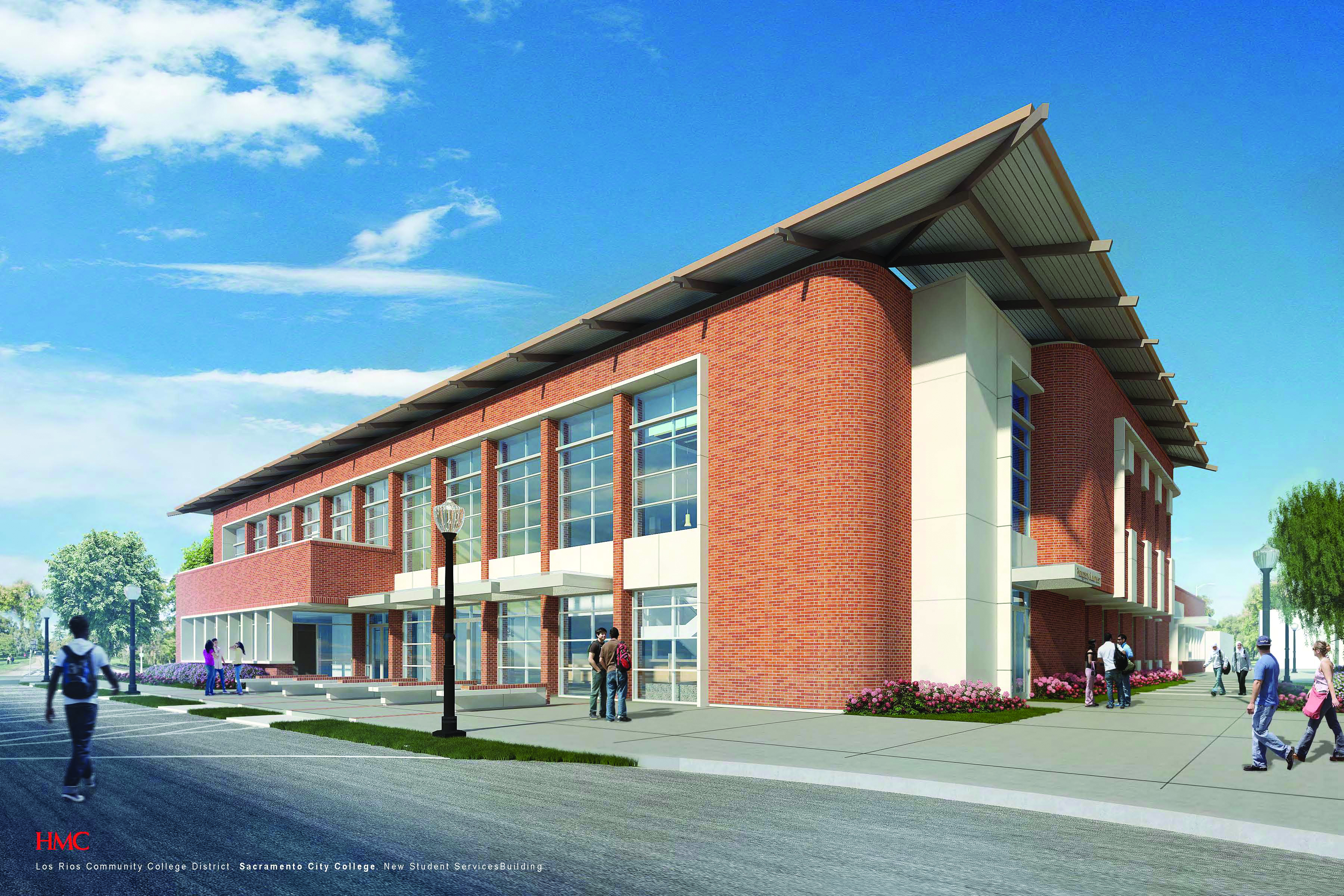
A rendering of the new Student Services building, which will replace the now deconstructed Student Services and Administration of Justice building by early 2015. Image courtesy of HMC Architects.

The Administration of Justice building will be torn down beginning June 17 to make way for a modern Student Services facility, projected for completion in February 2015, according to City College public information officer Amanda Davis.

The tear-down is one of many construction projects that will begin over the summer to improve the campus. Several parking lot improvements will also impact the college.

Once completed, the planned two-story Student Services building will house on its first floor many of the services now in Rodda North. On the second floor, the journalism and photography departments will reside in a joint state-of-the-art facility.

In addition to the new Student Services building construction, a makeover of staff parking in G lot, between Lillard Hall and Rodda South, will begin when the lot closes May 22, according to a campus email sent by Davis’ office. Construction is scheduled to be completed by July 22.

The improvements will include 12 additional parking spaces, new lighting, Americans with Disabilities Act compliance and safer, more efficient entry and exit points.

“There will be plenty of spaces in other staff lots to accommodate our needs,” Davis said.

East Road will also gain an additional six parking spaces for staff once the May 23 project begins. Traffic controls are expected, according to Davis. The construction will be completed July 22, as well.

Posted in News, Sac City Express (SCC) | Tagged , , , , , , , , , | Leave a comment

Campus construction project to begin in June

New two-story building to house Student Services programs, create new location for photography and journalism

Originally published in the May 7, 2013 print edition of the Sac City Express

sac city college student services, 2015 building

A rendering of the new Student Services building, which will replace the current Student Services and Administration of Justice building by early 2015. Image courtesy of HMC Architects.

A new Student Services building is scheduled to become part of the City College campus by early 2015.

According to Vice President of Administrative Services Robert Martinelli, the $8.4 million construction project will begin June 17 and last until approximately January or February 2015.

The construction has been contracted to J.F. Otto, which Martinelli said is the same contractor that built the City College parking structure.

The project was designed by HMC Architects in Sacramento and will begin after the demolition of the current Administration of Justice and Student Services buildings, which means that all services housed in those buildings have been or will be temporarily moved to other locations.

“The way we planned this [new] building is part of the overall facilities master plan,” said Martinelli. “The first floor is going to be student services. The second floor [will be] journalism and photography. I think there will be some synergism from the way the two programs work, so it’s going to be a good deal there.”

Dean of Financial Aid and Student Services Christine Hernandez explained in an email what services will be moving and where they will be accessible during the construction period.

“Primarily, these changes have been the relocation of Student Services programs that were previously located in the Administration of Justice and Student Services buildings,” said Hernandez. “CalWorks has already moved to Temporary 1, and Assessment has moved to Temporary 8. As the spring term draws to an end, additional moves will occur. Disability Services and Programs for Students, including College to Career and Workability, will be moving to Temporary 9, and the RISE program will move to Temporary 5.”

Hernandez also elaborated on all of the student services, which will move to the first floor of the new building upon completion.

“The first floor of the new Student Services building will be home to Information, Orientation, Admissions & Records, Assessment and DSPS,” said Hernandez. “There will also be administrative office space, counseling space and a multi-purpose room.”

Martinelli said that the Administration of Justice classes are currently being taught in classrooms at the West Sacramento Center as well as some classrooms at the main campus, which made room for DSPS during the Performing Arts Center modernization project.

According to Martinelli, after the journalism department moves into the new building from Temporary 3, that building will most likely be used as laboratory space during the eventual modernization of Mohr Hall and Lillard Hall. He said there will also be a modernization phase for Rodda North’s third floor to create more classroom and office space.

Martinelli said the H Lot parking lot, located between the construction site and Rodda North, will be fenced off and used for construction equipment during the project. The H Lot is dedicated to parking for people with disabilities, but Martinelli said the campus has plenty of other dedicated disability parking spaces and that Paratransit buses will have specific areas to drop off students as well.

Admissions and Records Supervisor Kim Goff was a part of the planning board for the new building and said she’s excited because it will bring together a lot of services that are currently spread out on campus.

“We’ll have the people in there who recruit students, [students will] be able to have their orientations in that building, [and] they’ll be able to go right to assessment from the orientation,” said Goff. “I think it’ll be much clearer to a student.”

Goff added that one of the main goals of the new building is to lower the number of students who get lost in the shuffle.

“The next step after you apply and do an orientation, we say you have to go do an assessment,” said Goff. “Even right now, you have to cross a little parking lot, and then sometimes they get lost or they get distracted. So this gives us a better opportunity to make sure they get in and take their assessment test before they see a counselor.”

She added that in order to make the processes smoother and faster, it’s important to help students know exactly what to do next.

“We’re always striving to make things less confusing,” said Goff. “[Rodda North] is not very friendly, you know, [because of] the way it’s designed. It wasn’t really designed for as many students as we have.”

Photography Department Chair Paul Estabrook was also a part of the planning board. Since the upper floor of the building will combine journalism and photography, members of both departments gave input about how they’d like to see the space utilized.

“We’re going to have a big, bad, new and improved and expanded photography program,” said Estabrook. “The coolest thing with journalism and photo moving together is creating a lot more opportunities. Some of the ones that come to mind, because I’m more the photo-centric person, is the newspaper or online publications can start using [photo] students and more of the equipment that we have in photography and multimedia.”

Estabrook said there will be several advantages to the new building, including more space, better equipment, updated seating and computer labs, but that the best part will be the building itself.

“I think we will be the only community college in California to have daylight studios, meaning full Southern exposure, high-vaulted ceilings with glass, which is a really unique studio space,” said Estabrook. “Most studios generally [have] no windows. Where they do have daylight studios, you’ll only see in big cities like San Francisco or New York, and the studios are super expensive to rent because they have to be facing a certain direction and have specific elements.”

Estabrook explained that the advantage of this type of studio is that photo shoots inside the building can take full advantage of the daylight, which he says will provide a lot of diverse learning opportunities.

Furthermore, Estabrook explained that this type of studio won’t sacrifice other methods of photography.

“[The studios] can completely black out,” said Estabrook. “So we have black-out curtains that come down to create a normal studio space. The type of things we can teach is going to be awesome, [and] from that point of view I couldn’t be happier.”

Overall, Goff said she’s looking forward to the new building because it will make everything easier for everyone involved and provide a welcoming entry point to taking classes at City College.

“It’s going to be nice looking,” said Goff. “Inside it’s going to be really open and friendly and inviting. When you’ll walk in, you’ll get an idea that’s a student-friendly environment.”


Posted in News, Sac City Express (SCC) | Tagged , , , , , , , , | Leave a comment

Editorial: Let’s (food) fight back against Monsanto

Originally published in the May 7, 2013 print edition of the Sac City Express

monsanto, manufactured cornThe consumption of food is unlike anything else in which humans engage. Everyone has his or her own tips and tricks for staying fit, their favorite diets and those foods they try to avoid, but often they just can’t stop themselves from overindulging.

For the most part, food industries make it pretty easy to know what we’re consuming.  There’s plenty of information available on the Internet about what those 12-letter chemicals in the ingredients section of our favorite snacks are made from.

But what about genetically modified foods or foods doused in harsh chemicals? For years companies haven’t been required to put this information on their labels. With the 2012 defeat of Proposition 37, a bill that would have required labels on foods containing GMOs, this continues to be the case in California.

As students, mostly of the younger generation and the next generation of leaders, politicians and family men and women, we need to be concerned about our health. Since the limited scientific data that exists points to GMOs having long-term effects, it’s today’s young adults and children who will be left dealing with this problem in the future.

One company that makes these products is Monsanto, which manufactures and produces genetically modified seeds and organisms to enhance the growth and lifespan of natural foods, such as fruits and vegetables.  The idea is to make these foods larger, last longer or keep insects and critters from ruining crops. Monsanto also manufactures Roundup, an herbicide that helps farmers (and backyard gardeners, too) kill weeds without harming their crops.

However, according to a recent Huffington Post article, GMO foods only serve the purpose of being immune to Roundup, yet Roundup is the main chemical sold to keep pests off crops. Since both the GMO foods and the Roundup product are made by Monsanto, it means Monsanto becomes more profitable.

What’s worse, President Obama recently signed the so-called “Monsanto Protection Act,” which, according to an article on fooddemocracynow.org, is a provision of a bill “hidden under the guise of a ‘Farmer Assurance Provision’ (Section 733), the provision strips the rights of federal courts to halt the sale and planting of genetically engineered crops during the legal appeals process.”

In other words, not only does this provision allow companies like Monsanto to get away with the continual sale of GMO foods regardless of whether a court rules a food unhealthy, it was passed as part of a larger bill that it had no business being included in. It wasn’t reviewed properly and didn’t go through a normal Congressional voting process.

So what’s so bad about GMOs and herbicides and pesticides like Roundup? In a recent study in the scientific journal Entropy it was found that “glyphosate,” which is the main ingredient in Roundup, has been found in food. According to an article by Reuters, “Heavy use of the world’s most popular herbicide, Roundup, could be linked to a range of health problems and diseases, including Parkinson’s, infertility and cancers, according to a new study.”

In another recent study performed over the entire lifetime of several rats, scientists found that “The animals on the GM diet suffered mammary tumors, as well as severe liver and kidney damage. The researchers said 50 percent of males and 70 percent of females died prematurely, compared with only 30 percent and 20 percent in the control group,” according to an article published by Natural News.

With companies like Monsanto gaining increased control of the FDA and the USDA’s ability to properly research and inform consumers, the GMO problem doesn’t appear to be one that will be easily solved.

Concerned students and community members can get involved in saying that we, as Americans, will not be treated this way. On May 25, there will be a national event called “March against Monsanto,” which includes a Sacramento-specific event. Many City College students have already committed to participate in the Sacramento march, which will be held on the same day.

Details about the Sacramento march can be found at the event’s official Facebook page. Regardless of the controversy of whether GMOs are bad for our health, the movement against Monsanto is really about keeping our rights as Americans and, more importantly, as humans to know what’s in our food.

Don’t let the government and big business decide what we put in our bodies. The surface of this issue has barely been scratched here, but the important thing to remember is that each individual person is responsible for his or her own health. Be informed and fight back against corporate control.

For more information on GMOs, Monsanto and where to find healthy, natural foods, visit www.saynotogmos.org.

Posted in Editorial, Sac City Express (SCC) | Tagged , , , , , , | Leave a comment