Scholarship money up for grabs

SCC Foundation and Transfer Center looking to help students fund their college careers

Originally published in the Feb. 4, 2014 print edition of the Sac City Express

Dalal Scarbrough (left), Linguistics major, asks about information to transfer to U.C. Berkeley while Simran Thiara (right), Economics major, acquires information to transfer to Sacramento State. Photo by Luisa Morco.

Dalal Scarbrough (left), Linguistics major, asks about information to transfer to U.C. Berkeley while Simran Thiara (right), Economics major, acquires information to transfer to Sacramento State. Photo by Luisa Morco.

Students who are looking for a little extra financial boost can apply for scholarships through the SCC Foundation or the City College Transfer Center.

Both the Foundation and the Transfer Center offer several scholarship opportunities for students, many of which require very little effort to apply, according to the facilitators of the programs.

The official website for the SCC Foundation states that scholarships are available to students who completed a minimum of 12 units at City College by the end of the 2013 fall semester and are currently enrolled in at least six units. Students must also meet the basic requirements for each scholarship and can apply for up to 10 different awards. The deadline to apply is March 7 by 4 p.m.

Additionally, the Transfer Center offers services, information and opportunities for students on how to put even more money into their college funds. On Feb. 11 from noon-1 p.m. in the Learning Resource Center, room 141, there will be a workshop to help students gather more information about these opportunities.

“They are one-hour sessions explaining the who, what and when of scholarships,” said Shannon Gilley, director of the Transfer Center. “There are many common questions students have, including how will a scholarship affect [their] financial aid.”

Ann Love, public services assistant in the SCC Foundation office, explained that the process to apply for scholarships, which are offered by various alumnus donors and other organizations, is simple, allowing interested individuals to easily navigate the online application system and complete the essays for those scholarships that require them.

“Names of volunteers and their contact information are posted on the SCC scholarship page, and students may call a volunteer for an appointment for help with applications,” said Love. “Also, students should always check to see that there are recommendations posted for them before the deadline.”

Recommendation letters are filed on behalf of students by faculty members, and students applying for scholarships are responsible for requesting them.

“Having only one recommendation, instead of the required two, can make the difference between receiving the award and losing it to a more conscientious applicant,” said Love.

For more information on the SCC Foundation scholarships, visit www.scc.losrios.edu/About_SCC/Foundation/ Scholarships.

For more on the Transfer Center workshops and scholarship opportunities, visit Rodda North 147, call (916) 558-2181 or visit www.saccity-online. org/transfercenter/scholarships.

Posted in News, Sac City Express (SCC) | Tagged , , , , , | Leave a comment

Master of his own fate

John Masterson pursues his dreams with a constant positive attitude and a contagious smile

Originally published in the Dec. 10, 2013 issue of Mainline magazine

Untitled

John Masterson stands proudly outside of the California State Capitol where he works as a constituent affairs assistant. Photo by Evan E. Duran.

A modest brick house surrounded by tall trees in a quiet neighborhood in El Dorado Hills is home to the Mastersons. On a Sunday afternoon, Kathy Masterson and her daughter Meg Masterson, who is over for a weekly visit and a barbecue dinner, work on a jigsaw puzzle in the living room while Kathy’s husband and Meg’s dad Mark Masterson is upstairs watching car racing on TV.

The neat and tidy home contains plenty of evidence that the rooms hold many memories of a loving, caring and happy family. Alongside the cheerful photos, mementos of events past and a lifetime’s worth of valued belongings is a driving force, who according to the Mastersons, has not only been the glue that has kept the family together, but is an integral part of who each member of the family is today.

On the couch in the living room, near Kathy and Meg, wearing a yellow T-shirt that reads “Best Buddies” and displaying a cheek-to-cheek grin that illuminates the room, sits Kathy and Mark’s son John, who was born with Down syndrome.

From being elected Oak Ridge High School homecoming king in 2004, to setting records in power lifting, to becoming friends with former California Gov. Arnold Schwarzenegger, John has achieved more at 29 years old than most people do in a lifetime.

Amid the challenges of living with an intellectual disability, John Masterson has pursued and accomplished every one of his dreams. John has held several jobs, graduated from City College and lived on his own. His friends and family say when John sets a goal for himself, he reaches it, and he does so with the enthusiasm of a child opening presents on Christmas.

The Masterson family moved from Dallas, Texas—where John was born on Dec. 3, 1985—to many places around the country before settling in their current hometown in 1997.

“Yeah! I remember that year! That was back when I was 12,” says John.

Sitting at the dining room table, located down the hall from the living room, Kathy, who works as a messaging manager for Intel, asks John if he knows he has Down syndrome, and he responds by saying, “Mmm-hmm.”

She explains that Down syndrome affects those with the disorder differently from person to person, and can cause other medical issues.

“That doesn’t mean everyone with Down syndrome is the same,” says Kathy.

Currently there are approximately 400,000 people living with Down syndrome in the United States. It is regarded as the most common genetic disorder in the nation with one in every 691 babies (6,000 each year) born with the condition, states the National Down Syndrome Society (NDSS) website.

“In every cell in the human body there is a nucleus, where genetic material is stored in genes,” states the NDSS. “Genes carry the codes responsible for all of our inherited traits and are grouped along rod-like structures called chromosomes. Typically, the nucleus of each cell contains 23 pairs of chromosomes, half of which are inherited from each parent. Down syndrome occurs when an individual has a full or partial extra copy of chromosome 21.”

However, Mark, who owns and operates Collector Car Garage, a car restoration business, adds that John and others with Down syndrome don’t differ much from the rest of society.

“When you look at people with Down syndrome, there’s just as much variety as there are with any population,” says Mark. “You have some people that are smart and some people that aren’t.”

Learning curve

John Masterson accepts an award in the 181-pound class, Special Olympian power lifting. Photo courtesy the Masterson family.

John Masterson accepts an award in the 181-pound class, Special Olympian power lifting. Photo courtesy the Masterson family.

Throughout John’s school years, Mark and Kathy worked with school personnel and others to make sure that John wasn’t treated differently because of his condition. Because the Mastersons moved around a lot, they experienced opposition at many schools to placing John into mainstream classes.

“We never thought he should be segregated,” says Mark as he leans back in his chair, looks over at John and displays a subtle smirk. “We thought that he should just be like every other kid because for us, he was. He’s the way he is like any other kid would be, so it was really important to have him included with his peers.”

Mark notes that the problem was usually a lack of understanding on the part of the schools about John’s individual abilities and requirements. As parents, he explains, it was important to present the school with feasible ideas about how to help John as opposed to just demanding the schools adapt their programs to the needs of one person.

“What we found was that if the school had something already set up, they wanted John to be in it because it was easier for them,” says Mark.

John and his family remained positive, and John prevailed in school with the help of classroom aides, modified work and the strong support of his parents. But John’s parents make it clear that John’s personality played a huge role in their success when it came to getting educators—like John’s fifth grade teacher who became an advocate for John after getting to know him during a class trip to the California coast—to meet John’s needs.

“[John’s] really likable,” says Mark. “So he helped himself in many respects. John’s the one that changed everybody’s mind. Everyone knew him. We’d go to maybe a [high school] football game or something, and everybody would go, ‘Hi, John,’ and it was very gratifying as a parent.”

Mark points out that it was always John’s positive outlook on life that allowed him to not only do everything he’s wanted to do, but to encourage others.

“The biggest thing is, I don’t think John ever thought that he was disabled,” says Mark. “I think that makes a big difference. He was never told he couldn’t do something because there was just never any reason to tell him that.”

Still, the Mastersons struggled to find a program to help John as an adult. But when they heard about the C.K. McClatchy Transitional Program, Kathy and Mark enrolled their son following John’s high school graduation in 2005.

“The school district remains responsible for education through [age] 22 for students with disabilities,” says Kathy. “We didn’t have anything up here [in El Dorado Hills] like [there is] down in Sacramento.”

The C.K. McClatchy Transitional Program, according to Barry Fallon, one of the advisers, is run out of a duplex near the City College campus. Its goal is to teach young adults living with disabilities, between the ages of 18 and 22, how to live independently.

Though it is funded through Sacramento City Unified School District, the program is run in conjunction with City College so that students can take college courses.

Classes are held on the main campus, the Outreach Centers or in the duplex itself. In addition to college curriculum, students learn domestic skills and work in various jobs. They also learn how to safely use public transportation and how to budget their money.

“We want all our students to have a fulfilled life, like anyone else would have,” says Fallon. “We try to fade out our support [over time] if we can. A positive attitude means a lot. John had a really positive attitude. John was never someone who said, ‘I can’t do it.’ ”

During his time in the program, John took classes at City College and held several jobs, including working at the City College cafeteria, William Land Golf Course, and in an internship with the Department of Justice.

“The classes that John took on campus were relatively limited,” says Kathy as she takes a break from her puzzle to rejoin the conversation.

She opens a window and asks if John wants some fresh air.

“Yeah, thanks, Mom!” John says with a grin.

“He took Trinidad [Stassi’s] classes [such as beginning jazz] for forever, and he took yoga,” continues Kathy, sitting across from John at the table, as John lays his hand on top of hers, and they smile at each other. “He took acting [and] John did a monologue where he had to be angry, and John’s not a very angry person, so that was really hard for him to do.”

John agrees that it was tough having to act angry, but he is proud of the outcome of the class.

“Oh, yeah,” says John with joy. “I’m really good at acting. I had a perfect grade!”

Leaving the nest

In May 2010, John Masterson carries the Olympic Torch in the Special Olympics Regional Track and Field Meet. Photo courtesy the Masterson family.

In May 2010, John Masterson carries the Olympic Torch in the Special Olympics Regional Track and Field Meet. Photo courtesy the Masterson family.

Following the completion of the program in 2007, John lived in one of the nearby duplexes with his younger sister and City College student Meg.

“I had this duplex,” says John. “I used to live there with my sister.”

Mark explains that John and Meg lived together for a year, and though it was a challenge for John, it was one of the life goals he wanted to accomplish.

“John had a very specific order for his life,” says Mark. “He wanted to graduate from high school, go to college, get a job and then live by himself. And he had done all of those things with the exception of live by himself. So, when this duplex opened up, we thought it would give him a great ability to do that last piece.”

But Mark says that for John, the new living arrangement wasn’t all it was cracked up to be.

“I think the concept of living alone sounded good on paper, but once he did it, he realized it wasn’t as much fun,” says Mark as he chuckles at John across the table.

Mark asks John what was hard about living on his own and John replies, “Well, because we used to pay for rent! It was hard for me. I want to live with my parents!”

Because John and Meg had signed a lease, though, John was faced with the reality that he had made a commitment and needed to fulfill it.

“He was real tough,” says Mark. “He stuck it out and did it for a year, and then at the end of the year, he moved back home.”

“Yeah!” adds John.

In 2007, through the Transitional Program, John landed an internship working in the California Governor’s office. The internship was through a program called “We Include,” which was started by former California First Lady Maria Shriver and launched officially in 2008.

Now called “California Includes,” the program aims “to increase employment of persons with developmental disabilities,” according to its official website.

“We were approached by [Shriver’s] office to place a couple of interns there in the Capitol,” says Pam Zaharie, another adviser for the Transitional Program. “John was one of the first to be placed. He was such a hit; he became very tight with the folks in the ‘horseshoe,’ the central command of the governor and staff, that they eventually hired him.”

John now works almost a full-time schedule for the Department of Developmental Services as a constituent affairs assistant.

Zaharie adds that because of John’s success, the governor’s office continues to work with the Transitional Program today. Many students who participate in the program gain work experience through internships at the DDS.

As John’s internship was coming to an end, he and his family were invited to a party at the Capitol to celebrate John’s 22nd birthday, which is when John first heard the news that he was being hired full-time.

“It was really surprising because normally you’d have a party at work, and maybe five people would sing, and you’d have a piece of cake and go back to your cube,” says Mark while John runs to his bedroom to grab the gift he received that year. “We get taken into the governor’s counsel room, and there’s like 40 people in there, and they’re all singing ‘Happy Birthday’ to John. And Schwarzenegger walks in and brings this gift and presents it to John.”

The next year for his birthday, the former governor gave John a crew jacket from “Terminator 3,” which John, upon
returning to the dining room, shows off with enthusiasm. Inside the jacket is a message from Schwarzenegger that reads, “Happy Birthday, love Arnold.”

Because John’s position was appointed by the former governor, his parents were worried that with the transition to Gov. Jerry Brown in 2011, John would be out of a job. John survived the administration change, however, and even received a raise.

Trishana Suman, senior constituent affairs representative in the governor’s office and John’s current job coach, says John is a “social butterfly” and enjoys being surrounded by so many people while working at the Capitol.

“John is a wonderful employee,” says Suman. “He is always taking initiative and [is] willing to do any task that is given to him with such enthusiasm. He is such a motivation to us all. He shows that regardless of what you have to work with, if you put your all into something, you will succeed, and it is such a beautiful thing to be able to see and experience that firsthand.”

Deadlifts and tandem bikes

John Masterson not only lifts weights in the World Association of Benchers and deadlifters but also lifts spirits of those around him. Photo courtesy the Masterson family.

John Masterson not only lifts weights in the World Association of Benchers and deadlifters but also lifts spirits of those around him. Photo courtesy the Masterson family.

John says he is very proud of having a job and that he is a hard worker. However, when John isn’t working, he enjoys watching clips from musicals on YouTube, listening to his iPod, competing in weightlifting competitions, and riding bikes to raise money for charity called Best Buddies.

“[‘Best Buddies’] purpose is to provide ongoing types of arrangements for people with intellectual disabilities like jobs, promoting friendships, basically doing things promoting self confidence to help them be more active and lead fuller lives,” Mark says.

Mark and John have raised about $20,000 for Best Buddies. Mark explains with a chuckle that John has not grasped the concept of riding a bike by himself, but riding a two-person bike has worked out well for them.

“Best Buddies ride with my Dad—we ride on the tandem bike,” says John in an excited voice. “Yes, we did!”

John also achieved the California state record for Special Olympians in the 181-pound weight class in bench press and deadlift in Chico in March 2013.

Jim and Shawna Sheffield started coaching John in power lifting seven years ago, and though lifting was dropped from Special Olympics, they continue training him two days a week. John participates in power lifting competitions through the World Association of Benchers and Deadlifters.

In November 2013, he competed in a world competition in Reno, Nevada where he won a Katana sword for placing first in both bench press and deadlift in the 165-pound special Olympian division weight class with lifts of 170 and 264 pounds, respectively.

“We love John,” exclaims Shawna. “He has made so many friends at our gym. He loves to show off his biceps. He has an effect on everyone at the gym because they see how hard he trains and they train harder. He lifts more than some people in our gym. If anyone is ever in a bad mood, I just say, ‘You need to go see John,’ and [their] whole world changes.”

Shawna says that John tries really hard and pushes himself to do his best.

“John wants to please,” says Shawna. “He never wants to fail. If he doesn’t make a lift, he gets upset, so we’re working with him to learn that even though you don’t get a weight, you’re not failing.”

The importance of family

John’s sister Meg says that even if she had the ability to turn back the clock and make it so John didn’t have to live with Down syndrome that, although it would make life easier for John, she probably wouldn’t take the opportunity. For Meg, John is who he is, just as he is.

“John’s condition has affected our whole family in that we have this really fabulous, consistent and loving presence in our lives,” says Meg. “Maybe a ‘normal’ brother would have done that, maybe not.”

Meg says this is why she calls herself John’s biggest fan and that she wouldn’t change him for the world.

“I think I’m most proud of [John’s] ability to grow into an adult,” says Meg, whom John refers to as his “beautiful sister.” “I mean, he’s got a job. He gets up and goes to work; he never complains. He’s the best brother in the world. He’s just the best. My brother says he loves me just because he can. He’s my favorite person on the planet. I love him.”

This article was awarded third place in the feature profile (magazine) category by the Journalism Association of Community Colleges as announced in April 2014 at the 2014 state conference.

Posted in Features, Mainline | Tagged , , , , , , , , , , , , | 2 Comments

‘A passion for fashion’

City College students turn a dream into reality with a start-up clothing line business

Originally published in the Dec. 10, 2013 print edition of the Sac City Express

Johnny Sam, 23, and Daniel Ocampo, 22, created the apparel company Stayseen Collective just a couple of months ago.

Johnny Sam, 23, and Daniel Ocampo, 22, created the apparel company Stayseen Collective just a couple of months ago. Photo by Guinevere Yep.

For many students, attending a community college isn’t just about completing coursework and earning a degree.

It’s also about exploring one’s passion and establishing business relationships that can last a lifetime.

City College sophomores Daniel Ocampo, sociology major, and Johnny Sam, flight technology major, met in English Writing 100 this semester and have since turned their friendship into a business venture, a clothing line called Stayseen Collective, that they hope will become a local phenomenon.

Ocampo says it took about four years to find someone who was serious about starting a business with him. He explains that the idea for the name came to him shortly after he graduated high school while he was considering the creation of a YouTube channel with some friends. Later, Stayseen Collective became the name of the clothing line.

“I just want to be visual,” said Ocampo.

But Ocampo says the people he originally worked with weren’t willing to commit to the venture as much as he would have liked, and it wasn’t until he met his friend and business partner, Sam, that the idea took off.

“I’ve gone through a lot of business partnerships with people and then I met [Johnny], and he had the same vision and that’s pretty much how it got started,” says Ocampo. “That’s when Stayseen became
much more serious.”

Now, the duo says they hope to turn their business into an outlet for helping local hip-hop artists promote their music. Ocampo and Sam began printing and selling T-shirts and crewnecks, which range in price from $18 to $28, approximately two months ago, and the initial printing of about 24 shirts sold out in approximately 48 hours.

According to Sam, who is in charge of marketing and advertising the brand, the next step for Stayseen is to promote their products at local events.

“We want to be out there, like where you walk through a store like at Arden Mall, you see [our] brand right there; we want to reach that goal,” says Sam. “In the meantime, we want to just be passionate and help other artists, help them come up.”

Ocampo’s vision for the clothing line is a little different.

“I wouldn’t mind walking through any type of mall and seeing our brand out there, but for me it’s more like I want to be able to express the true passion for graphic design,” Ocampo says.

Ocampo explained that some brands’ logos are too complicated or don’t necessarily convey a message, and that his goal is to keep their designs simple while still putting across a positive message.

“We’re big fans of hip-hop,” says Ocampo. “Instead of going out there and dealing drugs [or other illegal things] to make money, we take something that we have passion for and bring in other elements
as well. That’s pretty much how we market it. Right now, we’re just trying to target anybody that has a passion for fashion, anybody in the hip-hop game that’s just looking for a sponsor, that’s the people we try to target.”

Ocampo explains that the logo started out as a basic design using circles, which was inspired by a panda tattoo that Sam has on his right arm. Since Ocampo came up with the name of the clothing line, he wanted to integrate something from Sam into the logo. He says he noticed that Sam is always wearing a type of hat called a snap back, which is a traditional baseball cap that has a snapping mechanism on the back of the hat.

Ocampo took the idea of the snap back and added a line of stars to the logo to symbolize the snaps on the hat.

“I noticed as I was doing that, I started to see the form of an S,” says Ocampo. “And I was like, ‘OK, something else is missing. I’m just going to add a little smile to it,’ and there it is, it’s got the S, the snap back is in there, it’s got the eyes.”

The final logo resembles a smiling face, using the original circles idea, wearing a backward snap back cap, surrounded by the words ‘Stayseen Collective’.

But getting their name out there has been a bit of a struggle thus far because, as Sam explains, it’s tough to get noticed without connections. Both Sam and Ocampo say they have big dreams for their
brand’s future.

Still, Sam says even if the business takes off, he still plans to work in his field.

“I would say I’d love to work still,” says Sam. “Flight technology is my thing, and this being my side business; it doesn’t take a lot of work.”

For Ocampo, it remains a sort of a wait-and-see situation.

“We don’t know how far this is going to go,” says Ocampo. “I’m a working student right now, and balancing all this is hard, but if this goes better than I expect it to then this right here could be our professional job.”

Sam says City College reading professor Nancy Olsen is his “favorite professor” and that she is a big proponent of their brand. Olsen has encouraged them to branch out in terms of marketing, he
says.

Sam added that he and Ocampo contacted the Express after a suggestion from Olsen.

“I’m so impressed that [Johnny] and his friend, in the midst of going to college, have already started their business; I think that’s wonderful,” says Olsen. “I told him the [Express] would be fantastic
because it reaches all these students, faculty [and] staff.”

Ocampo says success comes down to being positive, dedicated and passionate, but that getting noticed takes time.

“Be patient,” says Ocampo. “You can’t do something and expect something [to happen] the next week. Just be patient with the things that you do and hopefully things will work out.”

For more information on Stayseen Collective or to purchase T-shirts and sweatshirts, visit www.stayseencollective.bigcartel.com or instagram.com/stayseencollective.

Posted in Features, Sac City Express (SCC) | Tagged , , , , , , , , | Leave a comment

Website redesign

New City College site to launch in spring, will focus on user experience

Originally published in the Dec. 10, 2013 print edition of the Sac City Express

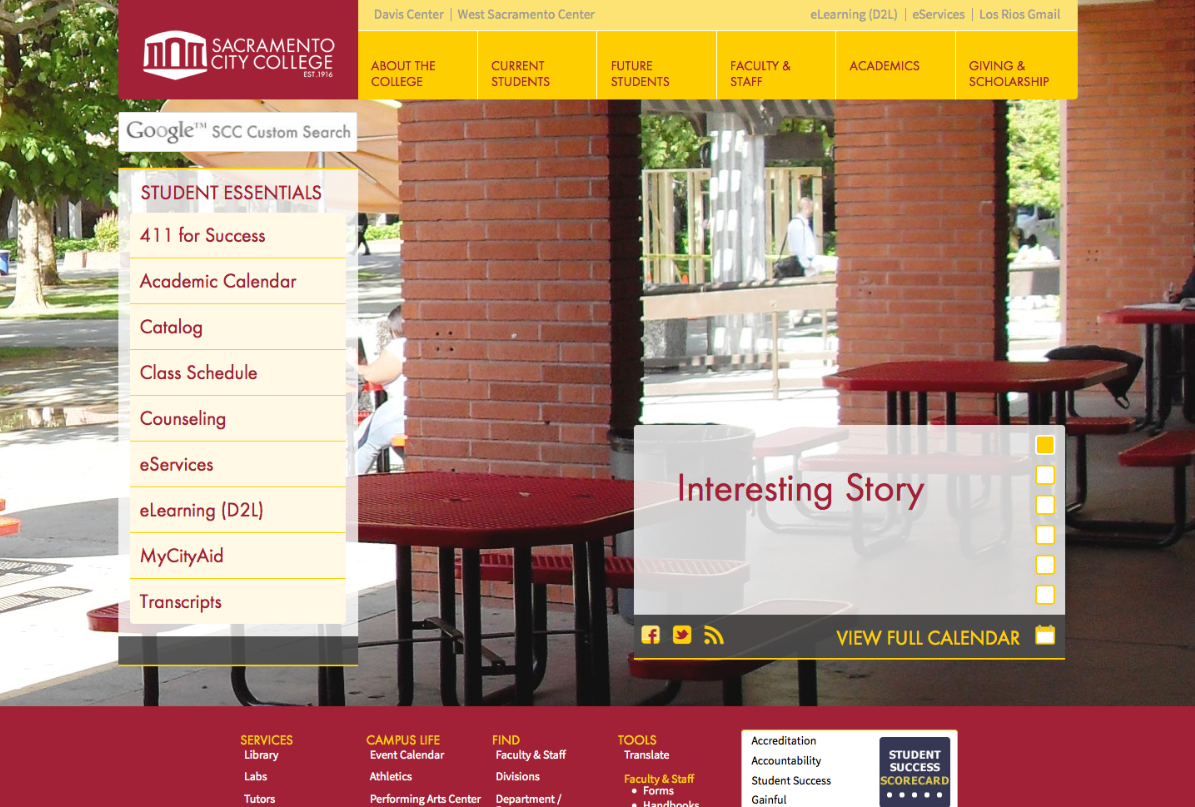
City College’s new website will feature a more organized layout and a dynamic home page, which will display news stories and important campus information.

Screenshot. City College’s new website will feature a more organized layout and a dynamic home page, which will display news stories and important campus information.

A team of faculty, staff and students at City College has been working since the fall of 2012 to deliver a new and improved version of the scc.losrios.edu website during the spring 2014 semester, said graphic communication professor and integral team member Don Button.

The new site will be responsive, among other many changes and upgrades, meaning that when it is opened on a mobile device, the site will resize itself to the user’s screen size, said Button.

Button, who worked on the site over the summer and is on sabbatical this semester while finishing it, said the biggest challenge is trying to find enough time to get everything accomplished.

“Our goal is to have the bulk of it, all the student services and the divisions, up and running,” said Button. “It’ll still be in beta through spring.”

The main focus of the redesign was to make the site easier to use for students in response to a recommendation by the accreditation committee, according to Amanda Davis, City College public information officer.

“It sparked the need to look at how our navigation is working,” said Davis. “So this web redesign team was pulled together, and we started looking at what we already have.”

Button explained that the original goal was to launch the new site in January, but because of a recent accreditation deadline change and concerns about launching during a busy time for site traffic, the site is now slated to launch in March.

“We realized switching the site right as the new semester was starting, when people might still be registering for classes and such, would probably cause more disruption than we thought initially,” said Button.

Along with Davis and Button, the team consisted of Quinn Nakano, reprographics programmer; Elaine Ader, dean of information technology, and Aaron Winters, adjunct graphic communication professor. The team planned and designed the look and features of the new site with the help of former City College graphic communication student Chris Hopkins.

Hopkins said he was asked to join the committee by Tom Cappelletti, City College graphic communication professor.

“I was the only student there,” said Hopkins. “There [were] a bunch of faculty members and then me, and we had all these discussions on the website. I was the student voice of that.”

During the design process, Hopkins worked with Button and Winters to map the current site, identify what content should be carried over and what was unnecessary.

In spring 2013, after the site was mapped and the final design was chosen, work on the site began. Button explained that the choice to use the WordPress platform, which, according to Wikipedia, is a “free and open source blogging tool and content management system,” was made because of its universal ease of use.

“We chose WordPress because it’s just the biggest, most popular, easiest to learn and powerful content management system,” said Button. “It’s worldwide and it’s also essentially free, compared to
paying thousands of dollars a year for a proprietary system.”

Button added that part of the overall project is to help train the people who will be responsible for updating their individual content in each department. The site was designed to make this process as painless as possible, he said.

“We’ve got a set of templates, and so there’s not a lot of room for individual creativity within the site, but we’re sort of focusing on keeping the visual presentation sort of clean and unified throughout all the sites,” said Button.

The reason for making the site more uniform is because the current site has a lack of continuity among the departments, according to Button.

“Our current site is sort of a mess in that way,” said Button. “There’s too much variation, a loss of sort of a brand identity for the school.”

Button said that the key has been working with the departments about how their content is organized.

“This way every department that a student goes to is going to be organized in the same manner,” said Button. “They’re going to know where they get the contact info; they’re going to know where they
can go to find out about the program.”

According to Winters, though he isn’t currently working on the site, his main concern in the beginning was to create a layered feel to the information on the new site.

“The way that it exists now is that it’s just very flat,” said Winters. “There’s no real hierarchy to any of the information. [We] tried to create more of a pyramid than a flat structure.”

Ader agreed that the new website will make the process of finding content smoother for users.

“We wanted to make sure the available information was easier to find,” said Ader.

Other new features will include a refined and more accurate search function, a redesigned library site, a universal calendar system and a home page that will highlight news and important campus information, Button said.

A focus going forward, according to Davis, will be to assemble focus groups to test the new site and collect feedback in order to continue refining the user experience.

“We’re going to be testing this with students,” said Davis. “[We’ll] do some focus groups with students, with staff and faculty…sit people down and say, ‘You know, here’s the new website, here’s a scavenger hunt, look for these things. Did you have trouble finding them? How did you find them? Did you use navigation? Did you use search?’”

Davis added that it’s important to stay current with industry standards in terms of what is user-friendly.

“You don’t build a website and then say, ‘OK, we’re good now,’” said Davis. “The technology, the user experience is constantly changing.”

Posted in News, Sac City Express (SCC) | Tagged , , , , , , , , | Leave a comment

Editorial: The importance of humanities

Originally published in the Dec. 10, 2013 print edition of the Sac City Express

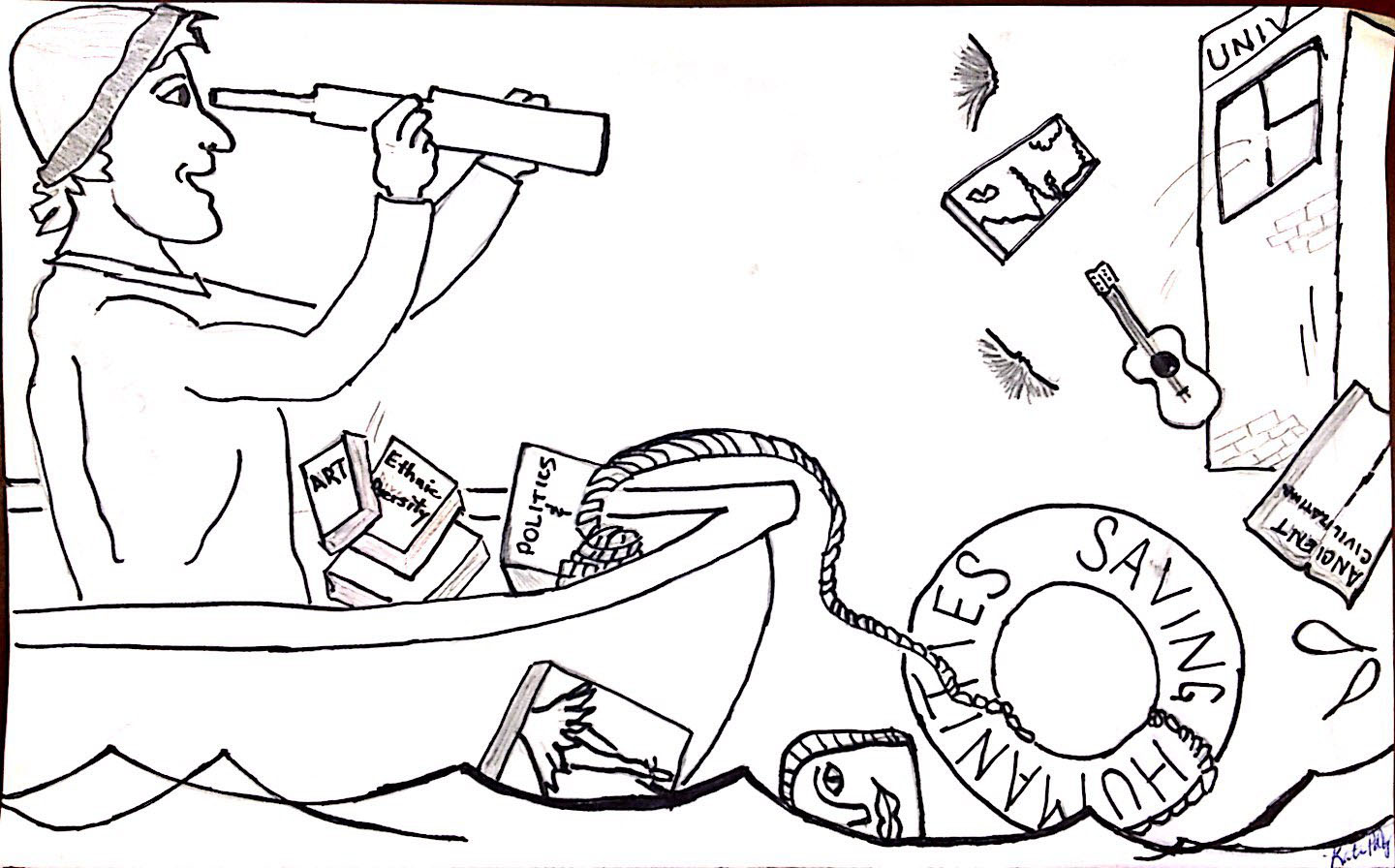
Photo Illustration by Kate Paloy.

Photo illustration by Kate Paloy.

“Do you think the main role of college is to make students ready for the job market? If so, why? If not, why not?”

This may sound like a test question, but it’s actually a question posed by Katherine Schulten in a Nov. 16 article in the New York Times. In the article, Schulten suggests that college students are losing interest in the humanities as majors.

She questions whether higher education should just be about vocational and job training as opposed to focusing on the teaching of critical thinking, expanding knowledge of the world and exposing students to diverse attitudes.

As the scope of college changes, especially at community colleges, it’s certainly an interesting and relevant question. How important is it to study  fields like philosophy, culture, languages, music, art and history when these are fields that don’t easily translate into jobs?

Obviously, they are important in elementary school, but are these subjects in which students should major?  The easy answer here is that unless one plans to teach within one of these  fields, it’s probably risky to earn a degree in one of them.

However, majoring in a subject like performing arts or theater could lead to jobs in acting. And studying history and knowing about important historical events is particularly useful in many facets of life. So not all humanities majors are futile. But when it comes to majoring in these subjects, it really depends on what one intends to do with such a degree.

On the other hand, pursuing more vocational majors like nursing, aeronautics, biology, business or other such fields opens graduates up to a plethora of jobs possibilities and opportunities for advancement. Not only that, but these are fields that can include hands-on training during college so that students can make absolutely certain they feel comfortable and ready to enter the workforce upon completion of these programs.

But college isn’t just about preparing oneself for a career. It’s about learning about life, learning how to analyze situations, learning problem-solving skills and social communication skills; it’s about expanding one’s horizons to become an educated and valuable member of society.

College can also be about trying new things. A philosophy class that a student signs up for just to fulfill a requirement might turn into a career in teaching or even a career in advanced study of the field. The reality of the matter, though, as pointed out in Schulten’s article, is that humanities programs are being cut more and more because of this lack of interest.

This is a problem that extends to elementary school as well with music and arts, the  first classes to get cut when budgets tighten.

As Schulten says in her article, Tamar Lewin’s Oct. 30 New York Times story points out that even at prestigious universities, interest in humanities is lessening.

“Harvard had a 20 percent decline in humanities majors over the last decade, a recent report found, and most students who say they intend to major in humanities end up in other fields,” states Lewin in the article.

This comment points to an interesting aspect of the problem: the idea that most students who start out in humanities eventually pursue other majors.

Even if students aren’t majoring in humanities and ultimately move into other  fields, such as science and technology, the information and knowledge gained in literature, history, philosophy or art classes are an integral part of the human experience.

Knowing about other cultures and other aspects of life, the origins of our societal norms and the evolution of our expertise is essential to understanding who we are and how we think. Critical thinking skills, the ability to analyze situations and being able to appreciate the world around us, including the works and accomplishments of the great artists, thinkers and musicians who walked the earth before our time, are some of the most important aspects of life.

Despite the fact that it isn’t easy to turn these subjects into a  financially stable career—even teaching is not a sure thing—studying the great humanitarians, artists and thinkers of the past is absolutely critical in shaping one’s own personality, interests, skills and abilities.

The humanities are a part of college life that we must protect and cherish.

After all, as the 28th president of the United States Woodrow Wilson said in 1911, “A nation which does not remember what it was yesterday, does not know what it is today, nor what it is trying to do. We are trying to do a futile thing if we do not know where we came from or what we have been about.”

Posted in Editorial, Sac City Express (SCC) | Tagged , , , , , , , , , | Leave a comment

Editorial: Volunteer to give thanks

Originally published in the Nov. 5, 2013 print edition of the Sac City Express

Kate Paloy, give thanks, Sac City Express

Editorial illustration by Kate Paloy.

The sights and sounds of the holidays are upon us, as Sacramento residents and Americans across the nation begin to decorate their houses for fall holidays—some even for Christmas already—and purchase hoards of goods from multiple retail locations.

The City College Panther statue was covered in pumpkins recently for a Queer/Straight Alliance club fund-raiser selling those plump little orange squash. While this was for a noble cause, raising money for a college club, it seems this is what the holidays have become more and more in recent years.

Specifically, Thanksgiving and Christmas have become so commercial that most people celebrate these holidays without even realizing what they’re all about.

Other winter holidays such as Kwanzaa, Hanukkah and New Year’s aren’t so bad, but in particular the celebration of Thanksgiving and Christmas have become more about how much we can eat or how many presents we can solicit out of our friends and family, than they are about giving thanks, or giving back, or even spending time with those friends and family members.

Black Friday—the biggest shopping day of the year—starts earlier and earlier each year. It has become a new tradition to go sit in line on Thanksgiving or to even go to stores that now open around 8 p.m. on the same day that everybody stuffs themselves with turkey and yams.

All of this makes one wonder why people don’t do more for those in need. The holidays have traditionally been a time of giving thanks and giving back to those who are less fortunate.

Sure, there are food drives, toy donations, soup kitchens and other such events and activities that help promote this idea, many of which are done on the City College campus, but maybe we as Americans should be upping the ante when it comes to helping others.

Statistically speaking, according to retailindustry.about.com, Americans spent $59.1 billion on Black Friday weekend alone in 2012. In comparison, there were 636,017 homeless Americans in 2011, according to endhomelessness.org.

Now, of course, the money spent on Black Friday wouldn’t be able to feed and shelter all those people, but the numbers speak volumes about the priorities of Americans.

Perhaps it’s just the nature of living in a capitalist country, but it’s sad to see so many people go without, many of them through no fault of their own, when people are willing to spend so much money on toys, electronics, clothes and other such frivolous expenditures.

There are so many other important aspects of winter celebrations to focus on, but it seems, at least in America, the main focus these days is to spend money. That isn’t to say there aren’t many people who do give back, and that’s great, but there is a huge opportunity to help even more, and not only at the holidays, but all the time. In fact, why do we view the holidays as the only time of the year when helping others is important?

One way City College students or those in the greater Sacramento area can help out is by going to sacramentofoodbank.org and clicking on the volunteer link at the top of the home page.

From there, interested individuals can learn more about volunteering and how they can help the community. For Thanksgiving this year, the food bank is running a turkey distribution line at its facility located at 3333 Third Avenue in Sacramento, which will be held on Nov. 25.

The organization also offers many opportunities for helping out year round, but for those who don’t have the time, money or ability to help out all the time, consider lending a hand to a fellow member of the community during the holiday season. Try walking in someone else’s shoes and ask yourself how it would feel to be ignored if you were in need.

There are so many ways, whether through City College or elsewhere, to get involved with helping those who are less fortunate than you. The important thing to remember is that while it’s perfectly fine to indulge during the holidays and while everybody is entitled to celebrate life, love and family any way they choose, there are a lot of people out there who have very little or nothing at all.

So, instead of sitting in front of the TV Nov. 28 watching football or instead of getting an early spot in line for that hot new toy your niece or nephew wants, think about collecting clothing for the homeless, volunteering at a local charity or collecting canned goods for the hungry.

After all, giving back is what the holidays should really be about.

In addition to the Sacramento Food Bank, there are many other places to help out during the holidays. Click here or here to find plenty of local volunteer opportunities.

Posted in Editorial, Sac City Express (SCC) | Tagged , , , , , , , , , , , | Leave a comment

Editorial: Nightmare on Job Hunt Lane

Originally published in the Oct. 22, 2013 print edition of the Sac City Express

job hunt, Daniel Wilson, Express, Sac City College

Editorial illustration by Cyrus Reed.

October marks the beginning of the holiday season, the onset of fall and the spooks, ghouls, ghosts and goblins that make it obvious it’s time to dress up in silly costumes and eat yummy mallow crème candy corn and Reese’s Peanut Butter Cups shaped like pumpkins.

For community college students, though, it can be a time of high stress as we look to  finish our last few classes before graduating with our  first degrees. On the other hand it can also be a time of excitement for those students just starting college, either following high school graduation or coming back to school for one reason or another.

In either case, the scariest time of the year can bring on nightmares of another kind. Ever thought about what you’re going to do when you  finish school? With your degree in your left hand and your resume in your right hand, you probably plan to walk up to your employer of choice and instead of asking, “Trick or treat?” asking, “May I have a job here, please?”

Statistically speaking, the résumé probably does more for a student—or former student—than the degree.  at’s not only a sad reality, but like a papier mâché ghost dropping down from a tree as kids walk up to a house hoping to add more candy to their pillowcases, it can be terrifying.

Take for instance, the results of a survey of approximately 1,000 future or recent college graduates conducted and published earlier this year by Accenture, a management consulting organization, which found that “41 percent of workers who graduated from college in the past two years say they are underemployed and working in jobs that do not require their college degrees.”

That’s not even the most hair-raising part of the  findings.

“The research also reveals that, despite their degrees, nearly two-thirds (63 percent) [of the recent graduates surveyed] say they will need more training in order to get their desired job,” according to an article posted on newsroom.accenture.com.

Of course, there are other post-graduation worries that keep students up at night. We don’t just mean that late-night party, long study session or marathon gaming tournament.  There’s the horribly horrifying thought of having to move back in with your parents while not only giving up independency, but also having to listen to Mom say, “I told you so.”

Not  finding a job right after graduation can also make students’ spines tingle as they regret taking out all those students loans instead of getting a job to help pay for school.  Then there’s what might just be worse than Freddy Krueger taking a victim to the depths of hell during a middle-of-the-night scare fest: the thought of going back to school because your career choice just didn’t pan out.

Perhaps there just aren’t enough jobs out there. Maybe you didn’t take the time to explore all of your options, or lack thereof, within the  field you chose, or maybe you just simply don’t like the career  field you worked all those years to get into because it didn’t turn out to be all it was cracked up to be.

But no matter what keeps you up at night, makes you want to sleep in till noon or simply keeps your hair looking like Medusa as you fantasize about turning your professors to stone because they had the nerve to give you so much homework, when it comes down to it, going through college and  finding a job in a career  field that interests you is one of the hardest tasks you have to complete in life.

Making the wrong choices now could mean a lifetime of unsettled rage toward your younger self.  The good news is that there are plenty of things that can be done to ensure this ghastly fate doesn’t become a reality.

Internships can help students decide whether they are well-suited for the career they’ve chosen. Vocational programs take this one step further since many of them have students working, to a certain degree, in the  fields of their choice.

There are also career  fields like journalism, graphic design, computer programming and many others where it isn’t really possible to learn the  field without going out and doing the work.  This is great because it forces you to try before you buy, so to speak.

Regardless of the career  field you choose, keep in mind that like wearing a silly costume to class on Halloween, it’s a decision that will stick with you for a very long time. If you’re unsure about the choices you’ve made, talk to a counselor, a parent, someone working in that career field. Make sure you are prepared before you set foot on stage to accept that degree because you don’t want your life turning into a scary movie.

Posted in Editorial, Sac City Express (SCC) | Tagged , , , , , , , , , , , | Leave a comment

Making smart choices in the City Cafe

Students, staff and cafeteria officials weigh-in on not-so-healthy food options

Originally published in the Oct. 22 print edition of the Sac City Express

food, cage, nutrition, daniel wilson, sac city express

The City College cafeteria shows a variety of healthy options. Photo by Guinevere Yep.

With the national rise in obesity, many people, including college students, have become concerned about what they eat.

According to the Center for Disease Control and Prevention, “more than one-third of U.S. adults (35.7 percent) are obese” and “obesity-related conditions include heart disease, stroke, type 2 diabetes and certain types of cancer, some of the leading causes of preventable death.”

For many, it can be inconvenient to bring their food or leave campus to eat. Because of time constraints or lack of transportation, often times, this leaves one option: the City Cafe.

But how healthy is the food on campus, what steps are the college taking to ensure healthy options for those who want them and who decides what food is served?

“Food service for LRCCD was contracted out in 2003, as I recall,” says Robert Martinelli, City College vice president of administrative services. “Aramark became the food service contractor through a competitive process in 2008. Their contract goes through the end of next year.”

Aramark representatives stressed that on-campus food options are mostly based on sales.

“When we choose what foods are going to be distributed out to the students, we will look at basically what sells and what does not sell,” says Frank Gleason, senior food service director for Aramark, the vendor that provides food served on campus.

Still, Gleason says there are healthy snacks offered, and some sell quite well.

“Some campus favorites are the everyday burger, which is less expensive, and the chicken patty burger, which is a healthier item on the menu,” says Gleason.

City College nurse Wendy Gomez is a part of the campus Food Advisory Group, which makes sure that prices are reasonable and, she says, also helps choose what foods go in to the cafeteria.

“We [the advisory group] make a strong effort on having healthy choices available, such as fruit, yogurt, sandwiches, salads and a taco salad bar,” says Gomez. “I think there are healthy choices if you look for them.”

For students, their food preferences come down to variety, but healthy choices are a concern, too.

City College student Lauren Smith, nursing major, says she only eats in the cafeteria Tuesdays and Thursdays, and she gets coffee in the mornings.

For lunch, Smith says, “I usually get pizza or salad. I wish there was a little bit more variety. If they had a better variety and quality, I’d be willing to pay a little more.”

Donald Williams, human services major, said he eats breakfast in the City Cafe Tuesdays and Thursdays, but doesn’t worry too much about making healthy choices.

“I get the burrito,” says Williams. “It’s got eggs, sausage, cheese and potatoes. To me, it is [a healthy meal].”

Williams added that he thinks his breakfast choices are pretty average and pointed out that the cafeteria does offer healthy alternatives.

“It’s the basic breakfast, basic lunch, right? Pretty healthy, I guess,” says Williams. “Plus they do have some salads over there.”

Jason Wong, social studies major, says he eats lunch at the City Cafe every day.

“I eat everything from the soup to the sandwich to the pizza,” says Wong. “I know the fruit is healthy, and I think the soup is healthy.”

Other students avoid the cafeteria altogether. Robert Curry, office administration major, says he seldom eats campus food, but not because of health concerns.

“I am on a tight budget, unemployed and receiving financial aid,” says Curry.

Though Curry’s reasoning for not eating cafeteria food may not be about health, he explained that he does think about his food choices.

“I am into health and wellness,” says Curry. “I do try to eat healthy. [The cafeteria does] serve healthy food, but they also serve junk food.”

Curry also speculated about possible reasons why the college doesn’t offer more health-conscious goodies.

“Schools operate on a budget and, depending on how the budget goes, they are able to bring in more healthy foods or just keep what they got because healthy foods tend to be more expensive,” says Curry.

Written in collaboration with Edwin Booze. Additional reporting by Priya McCluskey. 

Posted in Features, Sac City Express (SCC) | Tagged , , , , , , , , , , , , , | Leave a comment

Editorial: The debt of college education

Originally published in the Oct. 8, 2013 print edition of the Sac City Express

Sac City College, Daniel Wilson, student loan debt

Editorial cartoon by Brentino.

Student loan debt probably isn’t as common among community college students as with University of California or California State University students, and those who do carry debt most likely owe a lot less money than upper division students.

However, a great many students at City College will eventually move on to pursue bachelor’s or higher degrees and will take on heaps of debt—that is, unless they are fortunate enough to score a sweet, sweet scholarship or two or three.

Ask any student or parent who is paying for someone’s college education: Something needs to be done to make obtaining an education less expensive.

In fact, for most people, facing the inevitable amounts of money they’ll need to pay back for their oh-so-coveted higher educations is something that weighs on one’s conscience throughout their college careers.

But no matter how much we would like the threat of student debt to make like brick-and-mortar Blockbuster stores and disappear, it’s more like Cher in that it just won’t go away. The solution seems simple: Make college less expensive by cutting all the extras. Just charge for classes and books unless students opt to pay for other things like dorm space.

The fact of the matter is, though, that running a university costs a lot of money, and some of that cost is ultimately passed on to students who attend the institution, which is understandable. But accepting this reality doesn’t make the issue any less of a problem.

The cost of community college classes skyrocketed to $46 per unit at City College over the last few years. In addition, Politico.com reported, the federal student loan debt (including private bank loans) hit $1.2 trillion in July.

But good news came in the form of an announcement last January from Board of Regents member Sherry Lansing that a UC tuition increase would be “off the table” for 2013-2014, as opposed to the increases that occurred between 2006 and 2011, according to an article published by SFGate.

As optimistic as that may sound, the cost of going to a four-year college is on average $7,135 per academic year in the United States, according to collegecost.ed.gov.

Here in California, that average is blown out of the water with the highest priced UC, our neighbor in Davis, which ranks in with the ninth-highest tuition cost in the nation for public four-year colleges, setting students back $13,860 per academic year.

And if students take out federal loans to pay for tuition, interest is added on top of the already outrageous bill. As of July 1, federal loan interest rates stand at anywhere from 3.86 percent to 6.41 percent depending on the type of federal loan, according to studentaid.ed.gov.

On top of these ridiculously high rates and costs for upper division college, if one falls into a hardship or has difficulty finding a job within the six month grace period following graduation,

Current laws make it extremely difficult to receive assistance with managing payments, refinancing rates or in extreme cases, getting debt wiped clear.

According to Student Loan Borrower Assistant, “Student loans are difficult, but not impossible, to discharge in bankruptcy. To do so, you must show that payment of the debt ‘will impose an undue hardship on you and your dependents.’ ”

Successfully filing for bankruptcy in regards to a student loan is a hard-fought battle, but even if you manage to accomplish this, bankruptcies stay on your credit record for up to 10 years and can cause all sorts of other problems.

And while many ideas, plans and proposals are floating around to help those with high amounts of debt, such as the Federal Student Loan Refinancing Act, which, according to www.credit.com, was introduced in June by New York Senator Kirsten Gillibrand and would allow students carrying certain types of federal loan debt to drop interest rates to 4 percent, a universally acceptable solution has not been found.

Higher education is a valuable asset to those who are pursuing degrees, but as it stands, the U.S. federal and state governments aren’t making the ability to obtain degrees a high enough priority. History shows that attitudes about education spending have dramatically changed in the last three decades; just consider that community college courses were free a few decades ago.

Considering that so many employers see having a bachelor’s degree as a minimum requirement for employment, and the importance of the skills, abilities and knowledge that come along with a higher education, government officials need to start treating education as an essential aspect of one’s life as opposed to an easy-to-cut item on a budget report in times of financial desperation.

Posted in Editorial, Sac City Express (SCC) | Tagged , , , , , , , , , , , , | Leave a comment

Editorial: Smoking – To ban or not to ban?

Originally published in the Sept. 24, 2013 print edition of the Sac City Express

No smoking, Daniel Wilson, editorial, smoke or not to smoke, Express

Image borrowed from signsworldwide.com

The smoking of cigarettes is a topic that has created a deep divide among those who smoke and those who don’t.

We all know the health risks, yet many people continue to smoke. According to the U.S. Centers for Disease Control and Prevention, cigarette consumption kills more than 440,000 Americans per year, and second-hand smoke causes 49,400 deaths per year.

According to legalinfo.ca.gov, smoking in most enclosed workplaces in California, including inside restaurants and bars, was banned in 1995. In April 1970, advertising of cigarettes and tobacco products on TV was banned in the United States, says druglibrary.org. And from the 1970s to as recently as 2010, laws have continued to be passed in the United States to ban advertising on tobacco products including from magazines and billboards, according to Wikipedia.

It’s no secret that smoking in public places causes danger to smokers and those around them. When it comes to college campuses, smoking is just as much an issue as it is in other public places, and a lot more can certainly be done to help decrease the dangers of secondhand smoke.

The University of California will begin enforcing a new rule next year, banning smoking on all 10 of its campuses, according to a recent Huffington Post article.  The ban will be rolled out gradually, and the penalties for those who disregard the new policy are currently unknown, but it’s a step in the right direction.

According to Americans for Nonsmokers’ Rights, as of July of this year, “at least 1,178 college or university campuses in the U.S. have adopted 100% [smoke-free] campus policies that eliminate smoking in indoor and outdoor areas across the entire campus, including residences.”

Obviously, the trend of banning smoking altogether is gaining momentum. At City College, no smoking is allowed within 30 feet of many locations around campus. Those locations are indicated by signs, many of which have ashtrays underneath or nearby.

On our campus, the issue of smokers spreading second-hand smoke and leaving the campus a mess with cigarette butts and ashes is just as much a problem as anywhere else. For the non-smokers the Express spoke to, the solution seems simple: Ban smoking altogether.

To smokers the Express interviewed, the better solution would be to institute designated smoking areas around campus.

According to City College Public Information Officer Amanda Davis, this is an idea the campus has considered. However, she says having designated areas can cause problems like safety concerns if, for example, smokers were forced to smoke in the parking areas.

Cosumnes River College had similar concerns, but it has implemented designated areas and solved the issue of safety by keeping students who smoke out of the parking lots and putting them toward the back or the outskirts of campus instead, according to CRC Public Information Officer Kristie West.

If smoking is banned completely, students who smoke will just go to the sidewalks surrounding campus, and that could lead to complaints from the residents in the areas surrounding the college or from city officials, according to Davis.

Both solutions have their advantages and disadvantages for smokers and non-smokers alike, but even if no solution is reached and City College opts to continue enforcing current policy, at the very least, smokers should really try to practice some public-smoking etiquette.

There are several things smokers can do to be more courteous to the people around them:

1. Only smoke in areas that aren’t occupied by large groups of people. If there are a lot of people around, wait to light up until you are in a less-occupied location. This includes areas like the quad, under walkways or around classrooms on campus.

2. Never smoke indoors unless you have permission.  That goes for e-cigarettes, too. Not only is it illegal in most places, in others, it’s against established policy, and you might be cited for it.

3. Always smoke away from open doorways. Smoke can travel inside buildings. Also, try to avoid smoking in close proximity to building corners because smoke can travel around corners and  ll the faces of passersby with a giant cloud of potential lung cancer.

4. Never blow smoke in anyone’s face. Even smokers get annoyed by this behavior. In addition, try to stand so that your smoke blows downwind when in the presence of other people.

5. Try to avoid smoking while walking from one class to the next. Everyone walking behind you has to breathe in your excess smoke, and no one wants to do that.

6. Always use ashtrays.  There is no excuse for leaving the campus full of yesterday’s melancholy. That goes for litter and other such things as well. Take pride in the college you attend and keep it clean.

When it comes down to it, maybe doing something as extreme as banning smoking from college campuses completely is a bit harsh. After all, maybe designated smoking areas are an acceptable compromise.

But until a better solution is found to deal with the problem of second-hand smoke in public places, the least smokers can do is to try to follow some of these tips to be more responsible members of society.

You wouldn’t want the garbage man dumping trash all over you. In that same regard, non-smokers don’t want to bathe in exhaust.

Posted in Editorial, Sac City Express (SCC) | Tagged , , , , , , , , , | Leave a comment