Psoriasis is only skin deep

Facing the struggle of public judgment

Originally published Sept. 28, 2011 by SacCityExpress.com
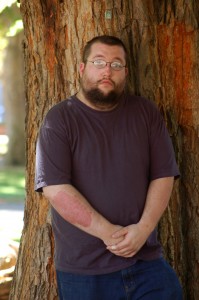
Daniel Wilson at Sacramento City College. Photo by Kate Paloy.

I’ve done it. You’ve done it. We’ve all done it. You see that person across the room that clearly has a physical or mental disability or condition and you can’t help but stare.

If you’re like me, you tend to wonder about the best approach to feeding your curiosity. The wonderful diversity at City College and in the world as a whole leads to seeing people of many different shapes, colors, forms, and backgrounds, but there are also those of us with conditions outside our control that can be embarrassing and frustrating to handle.

One such disorder is a skin condition called psoriasis. I was diagnosed with psoriasis in middle school and have dealt with it ever since.

According to www.webmd.com, “Psoriasis is a long-term chronic skin problem that causes skin cells to grow too quickly, resulting in thick, white or red patches of skin.”

Basically, psoriasis occurs as a result of the immune system overacting and causing skin cells to multiply at over double the normal rate. This causes skin to build up, flake off, and leave behind red, dry sores. Treatments include creams and ointments, ultra-violet ray exposure, and steroidal medications. These all carry their own risks, and many of them can have worse side effects than just living with psoriasis.

Web MD also explains that many factors contribute to psoriasis breakouts. Experts believe that it is a genetic disorder, but that hasn’t been confirmed. Stress, weather changes, use of alcohol or cigarettes, and in some people diet can also be factors in causing the condition to worsen.

My psoriasis started out on my head when I was in seventh grade, but it flared up in 2006 and now covers over half of my body, including my arms, hands, head, legs, chest, and back.

I use medicine to treat it and have learned a lot over the years about how to keep it from flaring up, but it’s a daily struggle that never gets any easier. On a daily basis I have to deal with intense itching to the point where sometimes I break down and cry.

I also deal with dryness, bleeding and for about a year, I had to wear half a box of bandages on my hands every day just to be able to function. I have extreme difficulty bending up and down due to dryness on my knees, and I have to deal with so much dandruff that it appears to be snowing on my t-shirts.

These are just a few of the frustrations I have to endure.

However, none of this is as hard to deal with as the frustrating, but understandable ignorance of the general public. I have worked in retail for seven years and have come across many people who want to know about the sores on my head and arms. There are some who ask nicely, I tell them it is psoriasis, and we leave it at that. Those people aren’t the problem.

It’s the ones who ask me anything from, “Did you get burned?” to “Was your skin ripped off by a bear?” Okay, so maybe that last one was a bit of an exaggeration, but you get the point.

Web MD also states, “Psoriasis is not contagious. It cannot be spread by touch from person to person.” This is another problem I’ve encountered at my job. One customer refuses to let me help her. She swears that my condition is contagious, even though I have told her that if I were contagious, I wouldn’t be working with the public.

It isn’t just the sores and the ignorance of the public that make living with psoriasis difficult.

Psoriasis makes even non-affected skin brittle, rough and easily susceptible to wounds, so certain tasks in my daily life and at work are almost impossible to complete without injuring myself. It’s difficult to explain to co-workers that I just cannot do certain things, and it can be just as difficult to get a doctor to issue a note explaining what, to them, is not an issue.

The medication I use is similar to Vaseline, so it’s a very thick, greasy ointment. It works wonders to keep the dry skin from building up and cracking, and over time it helps to even get rid of redness.

However, it can take hours to soak into the sores, and often I have to go to bed with it on my body. Not only is this a problem because it makes it difficult to sleep, but it also means I must bathe early enough to allow it time to at least partially sink into my skin before climbing into bed.

When I’m not working, this isn’t so much of an issue, but often I work back-to-back shifts, which pretty much requires me to go to bed as soon as I get home. On those nights, I have to deprive myself of sleep to allow myself enough time to use my medicine.

Sometimes people will ask me what I have, and after I answer, proceed to tell me that four or five people in their family have it. They always follow that sentence by telling me some home-remedy solution. This makes me wonder why they had to ask me what I have if they are so familiar with the condition.

The remedies are always entertaining though. I’ve heard anything from aloe plants, to tea tree oil, to rubbing lemon juice or alcoholic beverages on my skin. One person even suggested rubbing paint thinner on my sores. I just nodded and said, “OK,” while thinking to myself, “Yeah, I’ll get back to you after I burn off half my arm.”

It’s not a matter of sympathy that I seek, and I’m sure that those with disabilities, skin conditions or any other physical differences would agree. I’m not even hoping for people to keep their thoughts to themselves. I just want the general public to understand that if they’re curious about someone’s physical difference, ask him or her in a polite way and don’t try to offer him or her advice, unless they ask for it.

I can tell you from first-hand experience that it’s more embarrassing and frustrating to answer uninformed questions, especially from those that ask them rudely, than to just live with the condition I unfortunately have to live with for the rest of my life.

All I really want for myself and other people with physical differences is to be treated as if we’re just like everyone else. Equality is all we’re really after.

This article was awarded second place in the opinion category by the Journalism Association of Community Colleges 2011 state competition.

Posted in Opinion, Sac City Express (SCC) | Tagged , , , , , , , , , , , , , , | Leave a comment

Experimental math class debuts

Class combines math 100 and 120 for more credits

Originally published in the Sept. 13, 2011 print edition of the Sac City Express

Renee Medina. Photo by Jason Van Sandt.

It’s no secret that required prerequisite classes—such as math, history, and English—are difficult to complete because of a high demand for enrollment, but a new class offered at City College may just be the formula to solve the problem.

City College mathematics and statistics professor Renee Medina instructs an experimental mathematics course called  Math 299. This eight-unit course was created by the math division dean Anne Licciardi and combines elementary and intermediate algebra. The class meets Monday through Friday from 8:40-10:10 a.m. The plan is to offer it as a trial class for two semesters and if successful, it will become a permanent class, Medina said.

“The hope is to move students through algebra more quickly,” said Medina. “They won’t have time to forget, going from [Math] 100 to 120, and so far, it’s been a good class; [the students] are working hard.”

Medina feels that the demographic is pretty typical and she says that currently the class enrollment is approximately 40 students.

“I have never taught a class with this kind of range of backgrounds,” said Medina. “Right now I try to teach some stuff that’s really basic, and then I also show the stuff that’s harder.”

For those students who prefer a slower pace, Math 100 and 120 are still offered separately, and according to Medina, will likely be offered that way forever.

“There [are] different levels of students in there, and the pacing is pretty well spaced out,” said Robert Serrano, a student currently enrolled in the class. “There are students that don’t need help as much. There’s more time for the students that do need help.”

Medina also feels that the structure of the class not only allows for more one-on-one time with students, but that it allows for a more streamlined learning experience.

“Technically it’s less work than doing [Math] 100 and 120 separately because in 100 and 120, we do a lot of review, so all that review is gone,” said Medina. “So it’s a little less work—however, it’s much more intense.”

Overall, Medina said she feels the class will be successful and that she hopes to see it become permanent.

“I think the students who will be most successful will be the students who are very dedicated and really willing to put in the time and focus to get through this amount of material,” said Medina.

Posted in News, Sac City Express (SCC) | Tagged , , , , , , , , , , , | Leave a comment

The world as a textbook

From Down Under to Cali, geography prof. settles in

Originally published in the May 10, 2011 print edition of the Sac City Express

City College professor Richard Neil is a valuable member of the geography department. Neil’s unconventional approach includes using YouTube videos and his personal rock collection to teach students about the wonders of geography. Photo by Kate Paloy.

It is 7:30 a.m.

You walk into your class on the first day of the semester. You’re ready to learn. The professor walks in, blurts out the entire roll call in the most boring, unenthusiastic voice and announces an insane work load.

It’s going to be a long semester. The next day, however, is Saturday and though you’re not thrilled to be at school on the weekend, you are met with a pleasant surprise: geography professor Richard Raymond Neil.

Neil teaches a physical geography class at City College on Saturdays. He says his teaching method differs from others because he doesn’t just teach his subject, but makes the textbook come to life.

“I’m bringing the world to the classroom,” says Neil, who moved from Los Angeles to Australia at age 5 and lived there for 12 years. “When you share a planet with other people that don’t look like you, don’t think like you, and don’t talk like you, it’s even more important to know what’s out there. That’s part of what I try to bring to the classroom.”

Neil says teaching geography isn’t just about science, but about environment and culture. Along with geographical pictures and videos, he uses his personal rock collection and YouTube as tools.

“YouTube brings awareness that, believe it or not, not everybody is watching ‘Jersey Shore’ on MTV,” says Neil, 44. “There are other shows in other countries, such as Ireland or Australia, that people watch and enjoy. As Americans we’re missing out on these cultural opportunities.”

William Norton, a student in Neil’s geography class, says: “I really enjoy his class. He goes over conventional teaching of course, but he goes into alternate ways of teaching. He does make an attempt to make it real using pop culture references. One morning he showed a YouTube video of a late ’70s Australian pop band, and it made it a little bit more fun.”

Neil’s passion shines most when he is talking about Australia.

“I have seen kangaroos the size of bunny rabbits,” Neil says enthusiastically. “When people think of kangaroos, they think of these big giant things. They come in all shapes and sizes.”

Neil’s family moved to Australia when his father accepted a high school teaching job in the 1970s. “I have walked through rain forests where not another human being has ever walked through,” Neil says.

At the age of 18, Neil moved back to the United States to attend college. He received his master’s degree in geography from California State University, Northridge, a bachelor’s degree in geography from Sonoma State University, two teaching credentials in social studies from California State University, Los Angeles,
and an associate’s in liberal arts from Santa Monica Community College.

He is clearly respected by colleagues, as evidenced by the trouble he has on campus in going from point A to point B because he gets stopped by so many people who want to have conversations.

“He’s a valued member of our faculty,” says Craig Davis, City College geography professor. “He does a good job of communicating a subject that most haven’t had. I’ve always found Rick to be easy going, nice to talk to; he has interesting stories with living in Australia. He does a great job using his experiences to try to pique student interest and get some perspective from outside the classroom or even outside of Sacramento.”

Neil has also traveled to Mexico, Arizona, Hawaii, and through most of California. He says he hopes to one day have the time and financial stability to see more of the world.

A part-time professor for the Los Rios Community College District since 2004, Neil also maintains a full-time job for the state of California as a senior education specialist at CalPERS. But, Neil says, his true passion is teaching.

“Every time I present a unit, it’s different,” Neil says. “Every semester I get a different bunch of students so it’s almost like teaching for the first time all over again. As long as I stick to the subject and objectives, I’m free to present it in any way that I want. I have so much freedom of expression.”

This article was chosen as one of nine guest writer articles from an introduction to newswriting and reporting class to appear in the Express.

Posted in Features, Sac City Express (SCC) | Tagged , , , , , , , , , , , , , | Leave a comment

The future of news media: Far in the distance or right here and now?

Note: This is an unedited analysis of a State of the Media article that was posted as a project for an introduction to newswriting and reporting class at Sac City College in 2011. It does not represent my current work as a journalist.

9-onilne-the-web-surpasses-newspapersOn “The State of the News Media” website there are several articles discussing the current state of the media based on numbers, statistics, and other findings from 2010. One of the articles discusses the state of online media. The article summarizes several pieces of data about online media. Some of the areas the article discussed were ad spending trends, subscription model and user fees, audience and digital economics. Perhaps the most interesting part of the article was the section about audience.

The article showed the line chart pictured above, and discussed the generational changes in how people in America receive and follow their news. The chart lists several outlets such as radio, online, and television. According to the data, from 1991 to 2010 trends in TV, radio and newspapers declined steadily but online inclined at certain intervals. As you can tell from the chart, TV saw a drop between 2000 and 2002 and then jumped through 2004. After that it saw a steady decline until it recently tapered off. Online shows the most significance of a jump in 2006 as it jumps quite largely. In fact, from 2008 to 2010 the numbers jumped 29% for online news viewing.

The data in the article says that though TV remains in the lead, online is quickly catching up and has already surpassed TV with younger crowds. This means that publications which publish physical forms of their newspapers or magazines are not only losing readers but also revenue. The increase is significant; however, classic publications shouldn’t be alarmed as most of the online news was obtained from those same publications’ online formats.

The one thing that is clear is that television and online news media definitely seem to have gained the most ground and seem as if they are the future. A quote from the article states, “The web now trails only television (which includes both broadcast and cable) in popularity as a news source. The number of people who watched television news in some form “yesterday” was actually up slightly in 2010 to 58%.”

For me, I definitely see the future in online media; not only with news but with everything. Television itself is becoming more and more web-based and eventually the lines between online news media and television news media will blur. I think it’ll take a little more time and the changing of generations from the baby-boomers to modern generations before physical media will die out. This goes not only for written news media but for music, movies, video games and even books. The only question left to answer is whether this future is really all that futuristic or whether the future is now.

Posted in Journalism 300: Newswriting & Reporting (Sac State) | Leave a comment

Solving the job market woes; education may no longer be the only answer

Note: This is an unedited analysis of a Remapping Debate article that was posted as a project for an introduction to newswriting and reporting class at Sac City College in 2011. It does not represent my current work as a journalist.  

An article published on www.remappingdebate.org on Feb. 9 by Greg Marx, discussed why such a high number of college graduates who have earned Associate’s or Bachelor’s degrees have not been able to find jobs in their desired field in recent years.

The author’s main point was that in today’s economy in America, degrees are no longer guaranteed to help someone earn to their full potential. Because of rising costs, more women in the workplace, and cutbacks of middle class skill-based jobs – it is harder to find jobs that fit one’s degree specialization than it was in past decades. Still, those with bachelor’s degrees are maintaining higher wages than those that simply have high school diplomas. The issue lies more in the fact that these same degree holders aren’t able to work in their field.

The new way of the middle class job market has seen an increased need for post-secondary education and in many cases, special-skill training. The recessions in recent years have led to fewer jobs in the college labor job market. In other words, it is no longer a guarantee that a college degree will get you into a college level career.

One of the people interviewed in the article summed up the basic issue quite well. “There’s nothing that guarantees that supply [of college graduates] creates its own demand,” said Andrew Sum, director of the Center for Labor Market Studies at Northeastern University. “You’ve got to have more demand growth.”

According to the article there are many views for why this is happening. One view is that a lack of innovation is leading to fewer new jobs being created. Others say technology is at fault because as companies make better use of technology they no longer need as many employees. On the other hand there are those that feel education isn’t everything and that earning potential is reliant on one’s own abilities and skills.

Then there are those that oppose education as the answer to the problem and feel we should focus more on the on-the-job training aspect. They feel that the government should slowly raise minimum wage. Along with that, they say middle class jobs will become those that no longer need degrees, but still pay the amounts of money that degree holders have the potential to earn.

While I agree that there is definitely an issue here, I feel the solution lies in a mixture of a couple of ideas. Educating our population on not only job-related subjects and skills, but on the essential subjects such as history, science, and math among others is just as important. I don’t see why we can’t develop a system where education is about the general education but about on-the-job training just as much. Internships could earn you credits and take the place of formal classes. I also like the idea of having middle class jobs pay more but not need degrees. For example, why is a degree required for a management position at a retail store when it is such a skill-based occupation?

Source Article: http://www.remappingdebate.org/article/college-important-not-magic-bullet

Posted in Journalism 300: Newswriting & Reporting (Sac State) | Leave a comment

Segregation: A thing of the past?

Note: This is an unedited analysis of a Sacramento Bee article that was posted as a project for an introduction to newswriting and reporting class at Sac City College in 2011. It does not represent my current work as a journalist.  

20081125_charter_school2_33On the front page of The Sacramento Bee on Feb. 17 a story by Melody Gutierrez speaks of something long thought abolished: Segregation. Five new publicly funded charter schools will open in Calif. over the next five years. Separating African-American, Latino and Hmong children from their fellow students would allow educators to focus on the specific needs of these groups who, on average have lower test scores and higher dropout rates than whites and some other Asian groups.

The act of segregating students at these charter schools is legal as long as the school is open to all races and ethnicities. A professor at UCLA, Gary Orfield opposes these types of schools because he says, “To isolate these kids from other races isn’t preparing them for the future.” Orfield also told The Bee that he’d like to see more desegregating of schools in neighborhoods as opposed to further adding to the problem.

Margaret Fortune, the person responsible for getting the five charter schools approved by the Sacramento County Board of Education doesn’t believe it is a form of segregation because she says parents can choose whether to send their children to these types of schools. Fortune describes the charters as being similar to specialized academic programs, like technology and health services and says it’s about preparing low-achieving students for their college careers.

Though the lower scores and the higher drop out rates of these students corroborates in many research and study reports, is it justification enough to deny certain groups the diversity and cultural awareness that racially mixed schools offer? If children don’t learn about and accept the cultures, values, morals and beliefs of other ethnicities, the nation will never truly be free from racial tension. There are better ways of providing extra help to under-performing students than to throw them into a school away from their peers. It seems the educational ship is sinking and what we really should focus on is reforming and improving the system instead of just trying to plug its holes.

Posted in Journalism 300: Newswriting & Reporting (Sac State) | Leave a comment

‘Ease on Down the Road:’ A review of CSUS’s “The Wiz”

Originally published April 24, 2010

Note: This review was written as a class assignment for an introduction to newswriting and reporting class and published on Sacramento Press. It was not edited.

Sac StateFrom April 8 through April 24, California State University, Sacramento’s Department of Theater and Dance presented William F. Brown’s “The Wiz” for the entire Sacramento community to enjoy.

The play was directed by Melinda Wilson Ramey and choreographed by Linda S. Goodrich and featured the original songs by Charlie Smalls. “The Wiz” is of course the 1978 movie rendition of L. Frank Baum’s “The Wonderful Wizard of Oz” and Sac State’s students pulled off the show in a very impressive way.

Perhaps the best part of the show was Timothy Stewart’s portrayal of “The Wiz” himself which was full of comedy and slapstick and really got the audience involved. As he wore the oversize head in the awesome costume and used the fake hands to point in which direction he wanted his chair moved, he eventually got frustrated and stood up to just move around on his own–a moment that got a huge laugh from the audience. Stewart also joked with Dorothy about why she world ever want to leave Emerald City to go back to Sacramento.

Then there was the beautiful rendition of “To Be Able To Feel” performed by Ryan Thomas Blanning, who played the Tin man. And Ashli Fisher, who did an amazing job playing Dorothy belted out a beautiful version of “Be A Lion.”

The Lion and Scarecrow played by Sean Patrick Nill and Michael Blair Smith respectively were also great roles. Their comedic relief was a very popular aspect of the show. The rest of the cast did a tremendous job as well and overall the play was very well-done.

The play also featured several guest appearances from all over the Sacramento community. The Mayor of West Sacramento, Christopher Cabaldon, Good Day Sacramento reporter, Courtney Dempsey and Alexander Gonzalez, president of Sac State were among the list of 12 special guest stars who each played the role of an Emerald City citizen.

As with any performance though, it was not without its flaws. The audio wasn’t the greatest and it was hard to hear the lyrics of songs at times. Some of the quickly-spoken lines in the play were missed as well because of poor delivery. Sac State’s theater is quite small and it felt cramped sitting in the seats for about two and a half hours with only a short fifteen minute intermission. Urias Davis’s portrayal of Evillene, the Wicked Witch of the West was comedic and fun but a bit over the top. There also tended to be a little too much going on up on the stage at times.

Overall the play was wonderful though and the crowd involvement as the actors and actresses ran up and down the aisles made the audience feel as if they were a part of the story. This play was definitely worth the money and the hard work, effort, and level of dedication that went into this production were obvious.

“This production of the Wiz is several years in the making,” director, Ramey says in the program for the play. “Thank you for easing on down the road with us to Oz!”

And it was several years well spent as this was a wonderful presentation of “The Wiz.” If you ever have the chance to see a college production of the play in the future, do not hesitate to do so because it truly is a fun experience.

Posted in Arts & Entertainment, Sacramento Press | Tagged , , , , , , , , | Leave a comment

A.J. Academy adds two legal classes

Originally published by The River City Review inside the News-Ledger of West Sacramento on Sept. 25, 2002.

The Administration of Justice/Pre-Law Academy (A.J. Academy) went through some changes over the summer. Previously the Academy included physical education, English, and history classes. The administration has now eliminated this part of the program. This year Mr. O’Connor will teach a criminal law class during the first semester and a civil law class during the second semester. It is too late for the criminal law class but if you are going to need an elective second semester, the civil law class will be available.

Mr. Fonbuena’s A.J. class has also been changed to allow both juniors and seniors this year. Students can earn up to six units through Sacramento City College concurrently with River City credits. Mr. Pina explained that the A.J. Academy needs a larger enrollment as well as community/industry sponsorship similar to Intel’s sponsorship of the Engineering Academy in order to expand the program to learning activities such as field trips. Approximately 40 students were enrolled last year.

Mr. O’Connor and Mr. Pina will also be using this year to plan a new program for the A.J. Academy, which should be available during the 2003-04 school year. It will include an Emergency Services Program, which may include Emergency Medical Technician and Fire Control Technician information.


Editor’s Note: The Review is a high school publication at River City High School in West Sacramento, Calif., for which Daniel Wilson wrote and edited between 2000-2004. The stories published in this category appear in their original form with the only corrections being removal of hyphens for line breaks and the fixing of typos.

Posted in News, River City Review | Tagged , , , , , , | Leave a comment

Christmas memory a hard subject

Originally published by The River City Review inside the West Sacramento News-Ledger in 2001. Publication date estimated as the actual date is unknown.

My fondest Christmas memory is a hard subject because every year I have been at a different location or with a different person. My parents were divorced when I was about five and I have had Christmas at different places each year.

Last year my mom was forced to work on Christmas day and my sister and I had to stay with the presents taunting us as they lay under the Christmas tree. When she and my dad (he had picked her up from work) finally got there, we got to open our presents and I got one of the coolest presents ever an AIWA CD Player. I’d wanted a portable CD player since I was eight, which was when I started collecting CDs. I was so excited that I listened to it for about five days straight. I had to stop eventually though, because the batteries died and I had to replace them. That may not be my fondest memory but it was definitely something I will remember for a while.

Although I got a very cool present last year, I am looking forward to my present for this year. I have been pretty much begging my mom and dad to get me a Sony Playstation 2 because I want to get the newest WWF game, “Smackdown! Just Bring It.”


Editor’s Note: The Review is a high school publication at River City High School in West Sacramento, Calif., for which Daniel Wilson wrote and edited between 2000-2004. The stories published in this category appear in their original form with the only corrections being removal of hyphens for line breaks and the fixing of typos.

Posted in Opinion, River City Review | Tagged , , , , , | Leave a comment

RC Open House competes with Kings

Originally published by The River City Review inside the West Sacramento News-Ledger on May 30, 2001.

In spite of competing with the Sacramento Kings-LA Lakers playoff game, about 250 people came to River City’s open house, on Wednesday, May 2.

Unfortunately, many didn’t know about it considering it was postponed from the previous Wednesday. In addition, it was during the SAT 9 testing and people were probably too tired to come.

Ms. Doiron stated, “The people that came gave us positive responses and were pleased with it.”


Editor’s Note: The Review is a high school publication at River City High School in West Sacramento, Calif., for which Daniel Wilson wrote and edited between 2000-2004. The stories published in this category appear in their original form with the only corrections being removal of hyphens for line breaks and the fixing of typos.

Posted in News, River City Review | Tagged , , , , , , | Leave a comment